When you purchase through the links on my site, you support the site at no extra cost to you. Here is how it works.
Analog EQ emulations tend to fall into two categories: technically accurate circuit models that prioritize precision, and character-first designs that prioritize feel over measurement accuracy.
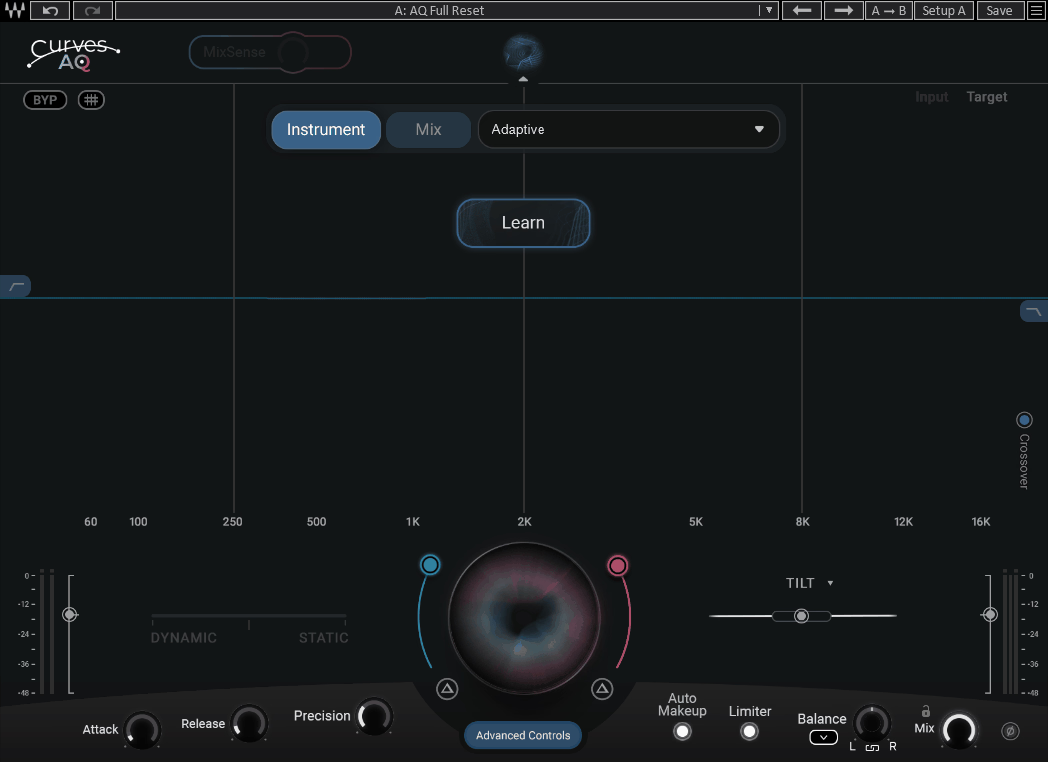
Waves positioned Curves AQ firmly in the second category, building it around the analog circuit behavior of vintage American EQ hardware with the kind of harmonic saturation and transformer coloration that makes the processing audible as a quality addition to the signal and not just a tonal adjustment.
On vocals, mix buses, and individual instruments it sounds genuinely musical in a way that clean digital EQs don’t naturally produce at equivalent boost and cut amounts.
The analog circuit character
I find the high-frequency boost character the most immediately distinctive aspect. Boosting air and presence on a vocal through Curves AQ produces a different result from boosting the same frequency on a transparent digital EQ, because the harmonic saturation in the gain stage adds even-order harmonics alongside the frequency emphasis that make the boosted region feel warmer and more integrated into the mix.
Waves Curves AQ models the gain stage saturation and transformer coloration of the original hardware, which means every adjustment you make introduces harmonic content alongside the frequency change. At moderate boost values between 3 and 6 dB, the saturation adds density and warmth that suits vocals, guitars, and full mixes where a clean EQ boost would introduce brightness without body.
You get the presence lift without the harshness that aggressive high-frequency boosts on clean EQs introduce on brighter vocal performances.
The low-frequency behavior reflects the transformer coloration of the original hardware, adding a subtle warmth and low-end density that I find most useful on mix buses and full mixes where the low end needs weight without additional bass boost. I use it at 1 to 2 dB of low-frequency boost on mix buses specifically where the transformer coloration adds the density I’m looking for without the mix becoming bottom-heavy.
What matters most:
- Gain stage saturation
Every EQ adjustment introduces harmonic saturation alongside the frequency change, producing a warmer, more integrated boost character that clean digital EQs don’t naturally generate at equivalent boost amounts.
- Transformer coloration
The low-frequency behavior reflects the transformer coloration of the original hardware, adding warmth and density to the low end that suits mix bus applications where the low end needs weight without obvious bass boost.
- Fixed frequency bands
The fixed band design mirrors the original hardware’s band structure, covering low shelf, low-mid, high-mid, and high shelf at the specific frequencies the original circuit was built around. That constraint is part of what gives the EQ its character, because the fixed frequencies were chosen for musical usefulness and not technical flexibility.
- Harmonic response at high boost values
At boosts above 6 dB, the saturation character becomes more pronounced and the harmonic coloration shifts from subtle warmth to obvious analog character. I find this range most useful on creative applications where the coloration is part of the sound design and not just a byproduct of the frequency adjustment.
Where it works and where it doesn’t
Vocals are where I reach for Curves AQ most consistently, specifically for the high-frequency boost character. The presence boost with harmonic saturation suits lead vocals in pop, soul, and R&B production where the vocal needs to cut through the mix without sounding harsh, and the fixed high shelf frequency sits at a point that suits most vocal material without requiring adjustment.
Mix buses and full mixes benefit most from the low-frequency transformer coloration, which adds the analog density that makes a digitally produced mix feel more cohesive and physical. I use it at the end of my mix bus chain at conservative boost and cut values where the character contribution is subtle enough to feel like a quality improvement and not an obvious effect.
Where it’s less convincing is on individual instruments with complex harmonic content like piano, strings, and acoustic guitar. The saturation character can introduce more coloration than the source benefits from, particularly at higher boost values where the even-order harmonics compete with the natural harmonic content of the instrument.
For those sources I’d use a more transparent EQ for the frequency management and reach for Curves AQ specifically when the analog coloration is the goal and not just a byproduct.
Pros:
- Harmonic saturation from boost and cut
The gain stage saturation integrated into every frequency adjustment produces a warmth and density that clean digital EQs don’t generate at equivalent settings, and the coloration feels musically appropriate and not like a processing artifact on vocals, guitars, and mix bus material.
- Transformer low-frequency character
The low-end density from the transformer coloration suits mix bus applications where the low end needs weight without obvious bass boost, and I find it one of the more transparent ways to add analog warmth to a digitally produced mix without obvious coloration.
- Fixed band musical usefulness
The fixed frequency bands from the original hardware circuit sit at positions that suit the most common mixing applications, and the constraint of working within those fixed points encourages musical EQ decisions and not the surgical adjustments that a fully parametric EQ tempts you into on every session.
Cons:
- Limited flexibility
The fixed band design is part of the character but also the primary limitation for applications requiring precise frequency targeting. If you need surgical EQ correction at specific problem frequencies, a fully parametric EQ covers that need more directly.
- Saturation at high boost values
Above 6 dB of boost, the harmonic coloration becomes obvious enough to be a creative decision and not a transparent frequency adjustment. On sources where clean frequency management is the goal, the saturation at higher boost values works against you and a more neutral EQ produces better results.
Verdict
The gain stage saturation, transformer coloration, and fixed band character combine into an EQ that adds warmth and density alongside the frequency adjustment, and on vocals, guitars, and mix buses specifically that combination produces results that clean digital EQs don’t naturally replicate at equivalent settings. That said, Curves AQ sounds quite musical to me.
It’s less useful if you need surgical frequency correction, precise parametric control, or an EQ that stays completely transparent at higher boost values. Curves AQ has a character that’s always present, and in applications where that character suits the material it’s one of the more musically satisfying EQs I’ve used at this price point.

Hey, I’m Vil, I started this site to help you find the best audio plugins covering various categories including synths, pianos, strings, and effect tools of all sorts as well. I pick these plugins based on various criteria so it best matches the actual topic.