When you purchase through the links on my site, you support the site at no extra cost to you. Here is how it works.
A convincing bass part is not just about having a good-sounding instrument. The most useful bass plugins are the ones that make it easier to get the playing style, articulation, tuning, and tone you actually need without spending hours fighting the MIDI.
That is why I would not choose the best bass guitar plugins simply by comparing how impressive their presets sound on their own.
For a broad starting point, Ample Bass J, NI Session Bassist Prime Bass, and IK Multimedia MODO BASS 2 are three useful places to begin because they solve different problems.
The rest of the list gets more specialized, from dedicated slap and fretless instruments to extended-range basses and a couple of capable free options.
1. Ample Bass J
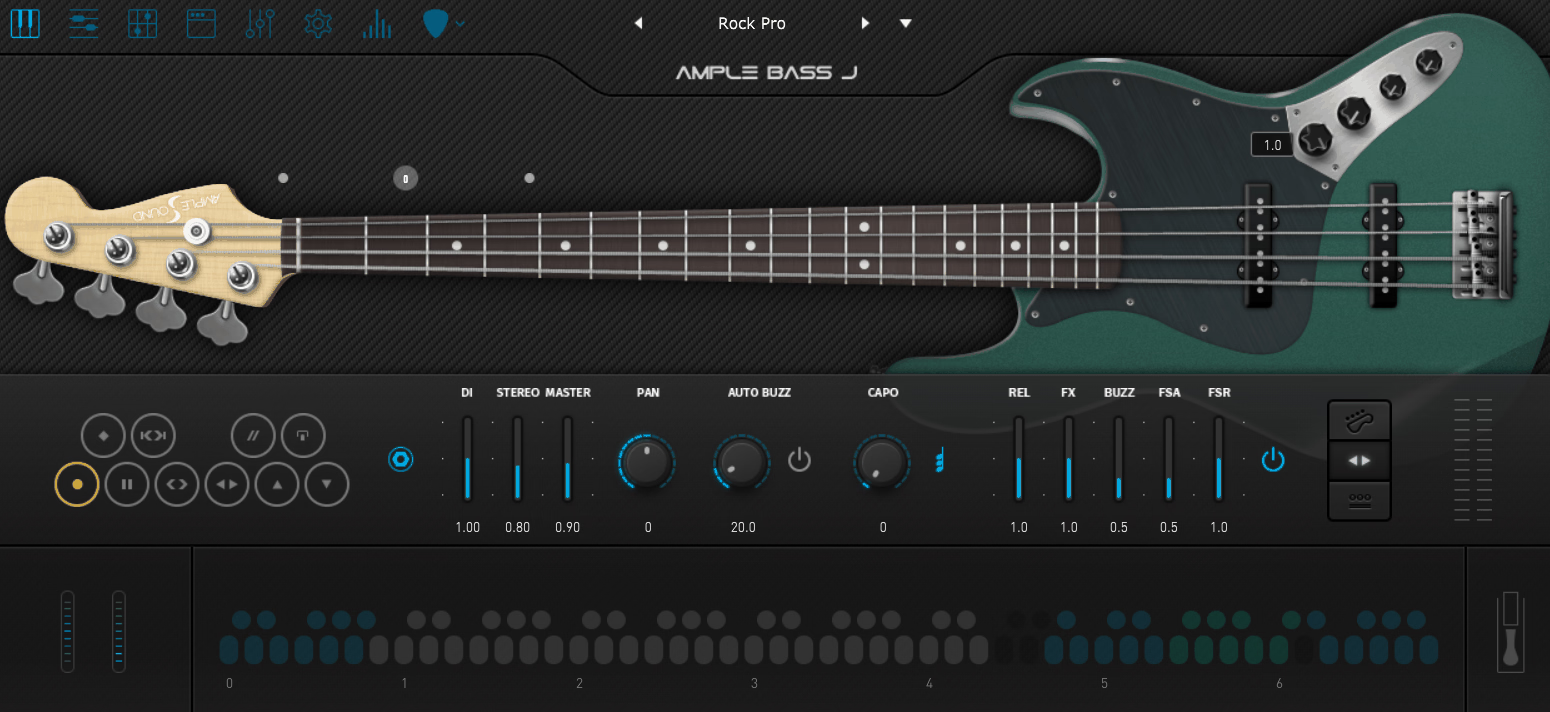
The reason Ample Bass J stands out is that it is built around a very specific instrument: a hand-built Jazz Bass made by Fender Master Builder John English. That gives it a distinct starting point, but the bigger advantage is how much control you get over the way the instrument is played.
It includes 13 articulations, covering everything from normal sustains and palm mutes to slap, pop, tap, slides, and dead notes. I’ve used plenty of Jazz Bass libraries over the years, and the feature I keep coming back to is the combined keyswitch system. Being able to put slap on one pair of strings and pop on another makes fast funk parts much easier to program without constantly stopping to change modes.
Two separate libraries are included for Fingerstyle and Pick playing, so you are not trying to make one recording cover both techniques. The tuning can also be pushed down to the lowest note of a five-string bass, which is useful when a track calls for a lower register without justifying another instrument.
- 13 Articulations
The articulation set covers sustain, palm mute, natural harmonic, hammer-on and pull-off, legato slide, slide in and out, slap, pop, tap, accentuated, repeat note, and dead note.
That is enough to handle most of the techniques you are likely to need in a conventional bass part, while still giving you options for funkier and more expressive lines.
I rely especially on the slap, pop, and dead-note articulations when a part needs to feel played rather than simply sequenced.
- Combined Keyswitches
The combined keyswitch system lets you assign different articulations to different string groups, so you can move between playing styles inside the same phrase without manually changing modes.
For fast rhythmic parts, that is a much bigger workflow improvement than it may sound on paper.
- Fingerstyle and Pick Libraries
Fingerstyle and Pick are recorded separately, which matters because the attack and feel of the two techniques are genuinely different. I would use fingerstyle for smoother lines and move to the pick version when the part needs a harder attack or more definition.
- Amp and Effects Section
Three amp models and four microphone options sit alongside an 8-band EQ, compressor, 6-tap delay, and convolution reverb.
The result is a library that can get close to a finished tone before you start adding external plugins. You still have room to build your own chain, but you do not have to.
- Alternate Tuning
The instrument can reach the lowest note of a five-string bass through its alternate-tuning system.
That is useful when you want the color of a four-string Jazz Bass but need more range at the bottom.
2. IK Multimedia MODO BASS 2
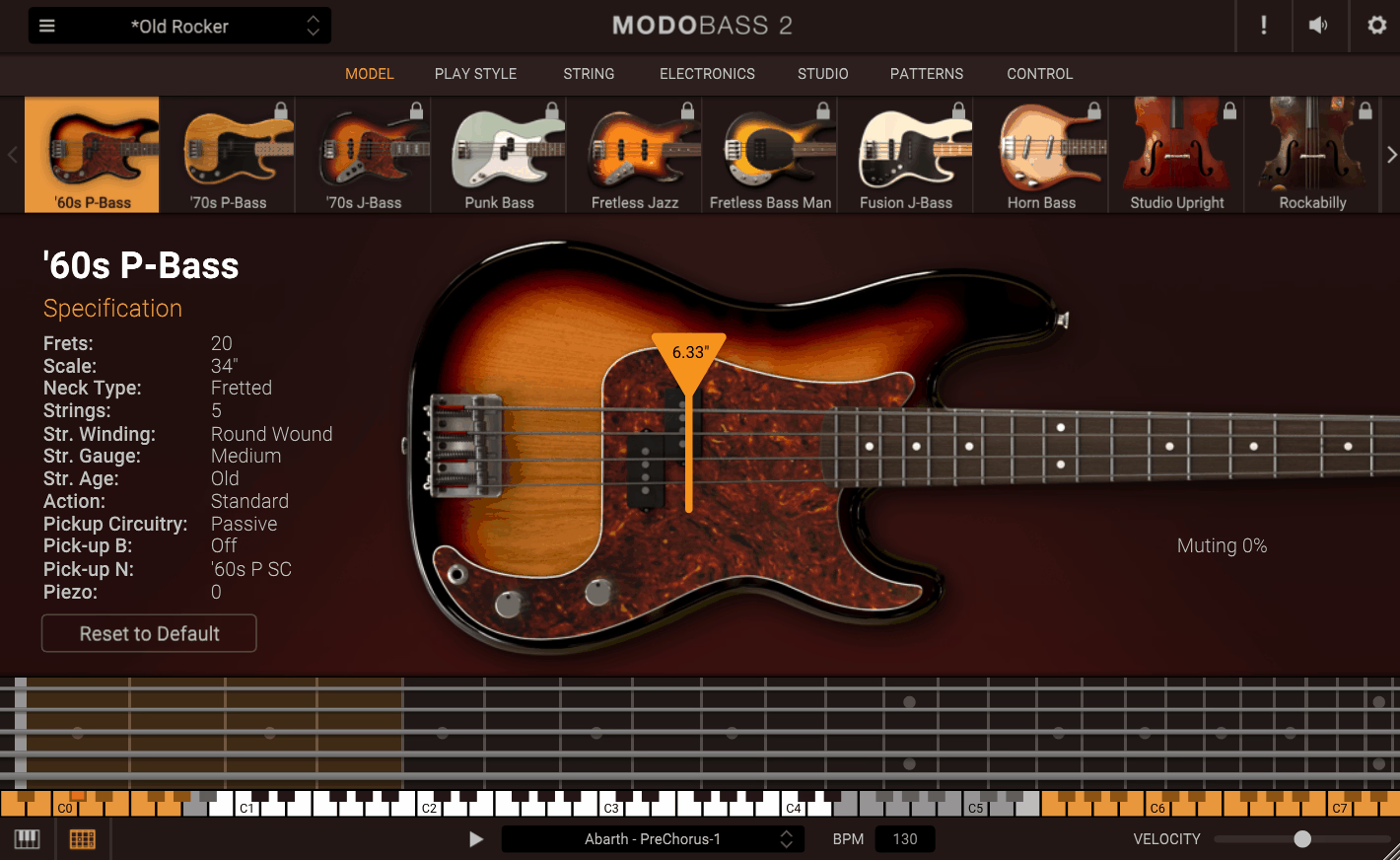
MODO BASS 2 instead uses modal synthesis to model the behavior of the instrument, including the interaction between the strings, fingerboard, body, pickups, and playing technique.
That distinction matters because you are not limited to the exact performance details captured in a recording session. You can shape the virtual instrument itself.
- 22 Bass Models Including Fretless and Upright
You get 14 original basses plus eight new models. Two of the newer instruments are acoustic double basses recorded in their own studio space with movable microphones and a blendable piezo signal, so the range is broader than a collection of similar electric basses.
It is the kind of library I would choose when flexibility matters more than the simplicity of loading one sampled bass and getting on with the part.
- Fretted to Fretless Switching
One of the more interesting features is the ability to switch any fretted bass to fretless without loading a separate instrument.
That does not reproduce every challenge of playing a real fretless bass, but it is a convenient way to audition both characters while keeping the same basic instrument underneath.
- Customizable String and Body Construction
MODO BASS 2 lets you adjust string gauge, age, construction, scale length, and string-to-fretboard distance, while pickup choices can be drawn from 32 options.
That level of control is useful when you already know roughly what kind of bass tone you want but the stock sound is not quite there.
I would leave most of these controls alone until the basic tone is working. There is little value in tweaking the virtual construction when the part itself still needs attention.
- Patterns Section
The built-in patterns section includes thousands of grooves, with performance parameters you can modify rather than treating the grooves as fixed loops.
3. Solemn Tones The Loki Bass 2
One practical detail about Loki Bass 2 is that it is designed with a very specific job in mind: modern, mix-ready metal bass.
Its Enforce Mode replaces problematic sub-bass information with a clean sine wave, giving you a controlled low-frequency foundation when a performance is not behaving as cleanly as you would like.
That is useful because the cleanup normally happens later in the chain with a separate corrective plugin. Here, part of that job is already built into the instrument.
The library itself is based on a Dingwall NG2 bass and includes five pre-processed tones built around a Darkglass B7K and Parallax, alongside a clean DI option.
The focus is narrower than something like MODO BASS 2, but that is also the reason to choose it: if your track lives in modern metal territory, you can get to a usable result quickly.
- 20 Articulations
You get down picking, up picking, alternate picking, fingerpicking, dead mute notes, harmonics, slaps, slides, bends, open plucks, dead plucks, and left-hand mutes, among the other included techniques.
That is a deep articulation set for a bass built around such a specific style.
- Five Pre-Processed Tones Plus Clean DI
The five processed tones are aimed at metal rather than trying to cover every possible genre. I would start with those presets when speed matters, then move to the clean DI once you know exactly what you want to build yourself.
- Enforce Mode
Enforce Mode replaces problematic sub-bass information with a clean sine wave.
4. Waves Bass Slapper
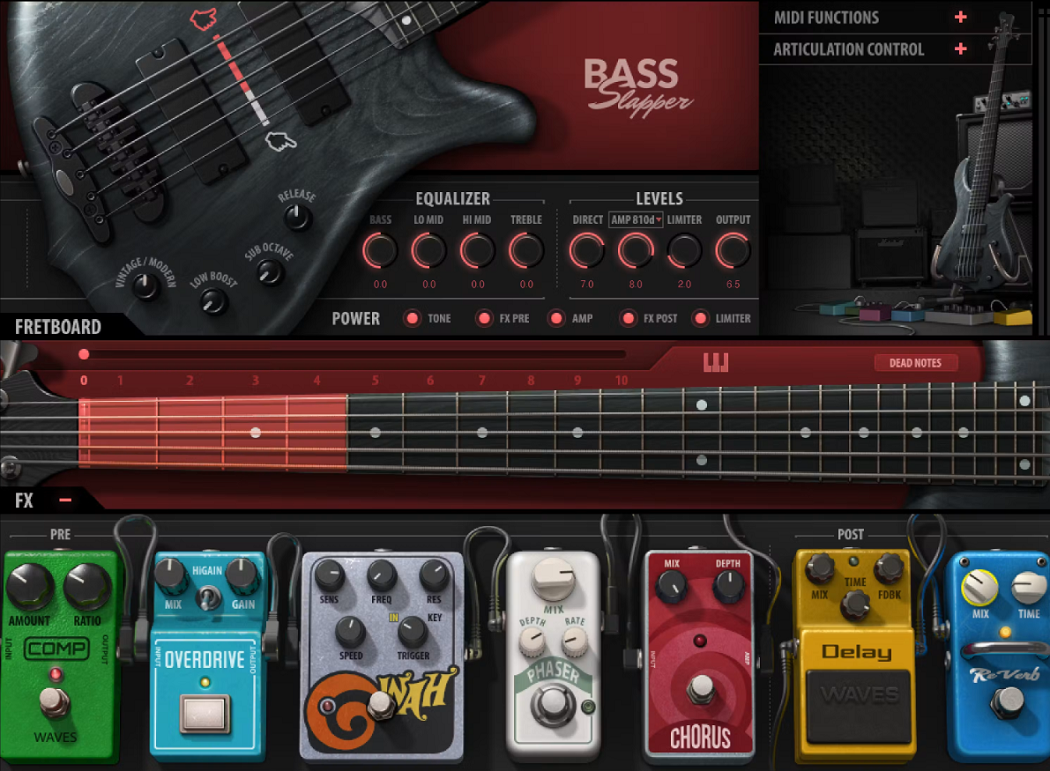
Slap bass is one of those techniques that can expose the weaknesses of a sample library quickly. The attack is sharp, the timing is obvious, and the sustain needs to feel natural.
Waves Bass Slapper takes a specialist approach by concentrating on that style rather than treating slap and pop as secondary articulations on a general-purpose bass.
The library contains 3,700-plus multisamples, with natural sustains rather than obvious loop points, and uses 11 playing positions so the same pitch can be played from different places on the neck.
That makes it useful when the problem is not “I need a bass library” but “I need this specific slap part to sound convincing.”
- 3,700+ Multisamples, No Loops
The notes are sampled with natural sustain rather than relying on obvious repeated loops.
That becomes important when a slap note has to ring out long enough for the player-like decay to remain audible.
- 11 Playing Positions
Automatic string switching moves notes between different positions on the neck.
The reason this helps is simple: the same pitch does not sound exactly the same everywhere on a real bass, so position changes add variation without requiring you to micromanage every note.
- Full 5-String Articulation
The library covers thumbing, popping, mutes, hammer-ons, pull-offs, open strings, legato, and dead notes.
For funk and slap-heavy parts, those techniques are more important than simply having a huge collection of unrelated articulations.
I especially like the hammer-on and pull-off mapping for fast runs that would otherwise take a lot of manual programming.
- Studio-Grade Effects
Stompbox effects, a 4-band EQ, sub octave, low boost, clean DI, and amp tones are all available inside the instrument.
That means you can take the performance from programmed notes to a usable bass sound without immediately leaving the plugin.
5. Ample Bass P
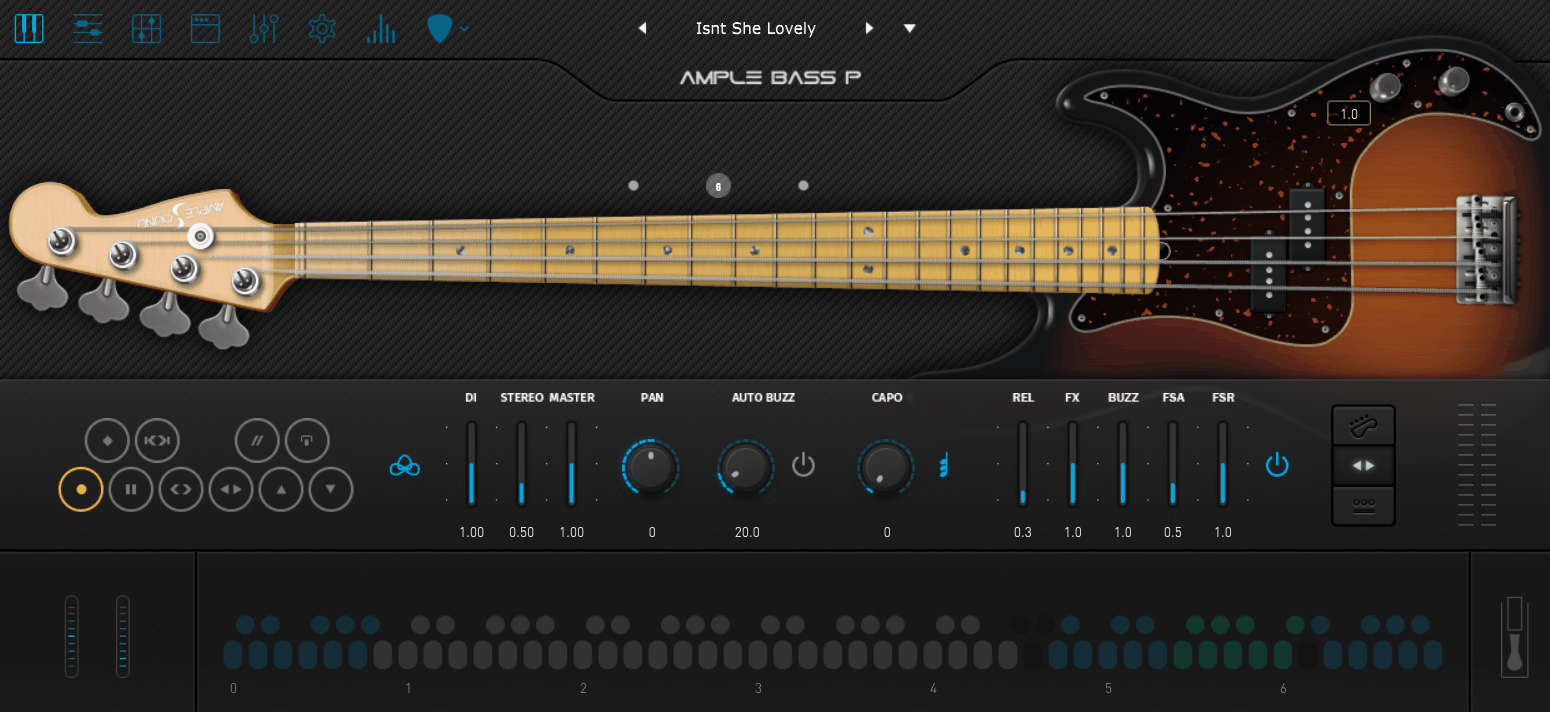
Ample Bass P is a more straightforward choice than some of the instruments above.
It is built around the familiar character of a Precision Bass, with the same general playing depth you would expect from the Ample Sound approach: multiple articulations, separate playing styles, alternate tuning, and an onboard tone-shaping section.
I would choose it when the track needs a classic P-Bass role and I do not want to overcomplicate the decision.
- 13 Articulations
The library includes sustain, palm mute, natural harmonic, hammer-on and pull-off, legato slide, slide in and out, slap, pop, tap, accentuated, repeat note, and dead note.
That gives you enough range for standard rock, pop, funk, and other parts that need a convincing Precision Bass foundation.
- Fingerstyle and Pick Libraries
Separate Fingerstyle and Pick recordings give you two genuinely different attacks rather than asking one source to cover both.
Fingerstyle is the obvious starting point for a warm, traditional P-Bass sound, while the pick version makes more sense when the part needs extra definition.
- Drop Tuning to B0
The instrument can be tuned down to B0. That is useful when a four-string Precision-style instrument needs to reach further into the low register without forcing you to switch to a dedicated five-string library.
- Amp and Effects Section
Three amp models, four microphone options, an 8-band EQ, compressor, delay, and convolution reverb give you enough control to shape a finished tone inside the instrument.
That is convenient when you want to move quickly from MIDI to a workable mix sound.
6. Native Instruments Scarbee Rickenbacker Bass
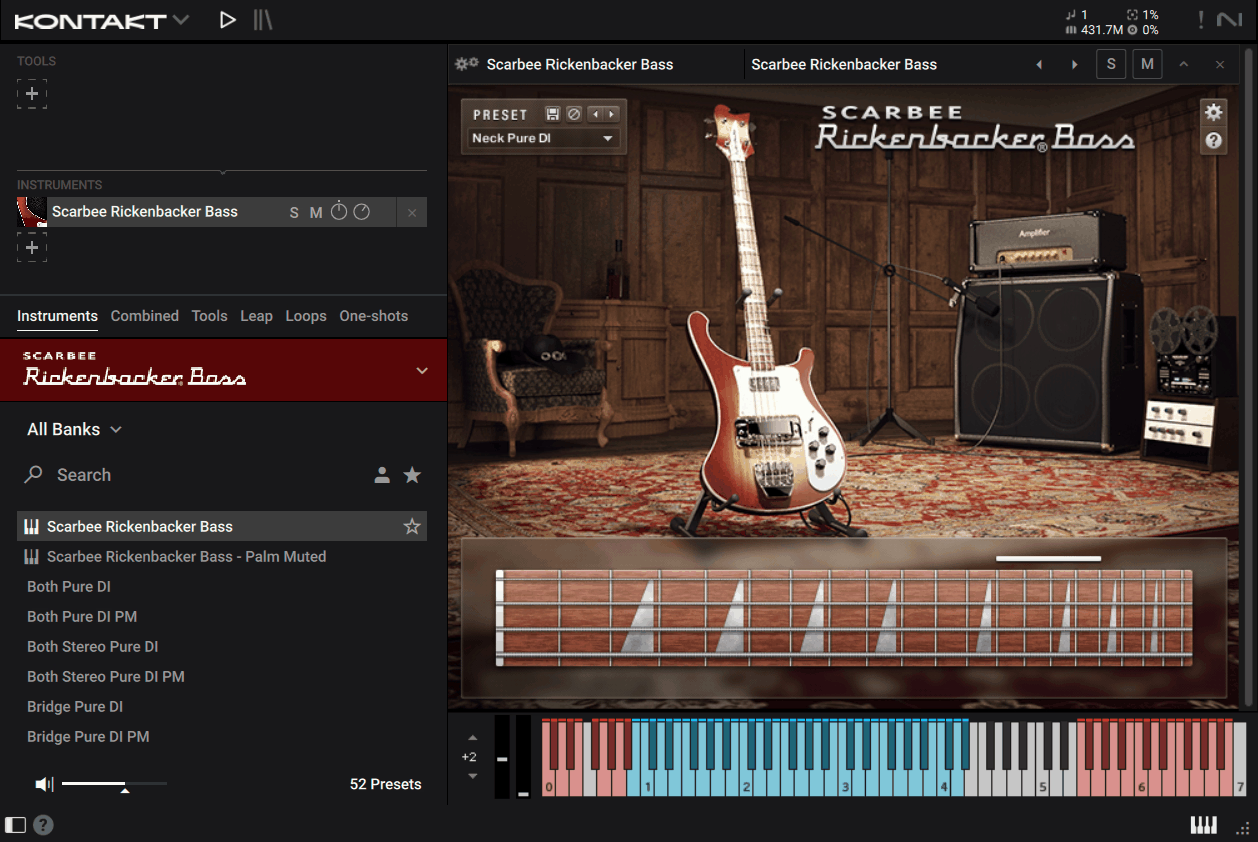
The Rickenbacker 4003 is difficult to confuse with a generic electric bass. Its sound has a particular combination of deep lows and pronounced upper-mid character, and that character is exactly what makes it useful.
Scarbee Rickenbacker Bass approaches the instrument in a way that preserves one of its most distinctive features: the Rick-O-Sound stereo output.
Instead of committing the neck and bridge pickups to one fixed blend, the library gives you access to them separately so you can process and balance them yourself.
This is also a notably pick-oriented instrument, so I would look at it when you want the aggressive, articulate side of a Rickenbacker rather than another general-purpose fingerstyle bass.
- Rick-O-Sound Dual Channel
The neck and bridge pickup signals are separated, allowing independent blending, panning, and processing.
That is one of the most useful features here because it gives you more control over the exact balance of warmth and bite.
- Open and Palm-Muted Picked Articulations
The open and palm-muted articulations are based on real pick-hand technique rather than relying on the instrument’s built-in foam mute. That preserves more of the natural change in attack and decay you would expect from a player changing hand position.
- Performance Style Presets
The library includes styles such as pop and country, soul and funk, and rock and retro, with settings for stroke detection and hand position behavior.
I tend to start with the rock-oriented options and adjust from there because the basic character is already close to what I want from the instrument.
- Built-In Effects Chain
A Jump Amp from Guitar Rig, plus tape saturation, EQ, and compression from the Solid Mix Series, gives you enough processing to shape the sound without building the whole chain yourself.
That keeps the instrument useful as a finished sound source rather than only as raw bass samples.
7. NI Session Bassist Prime Bass
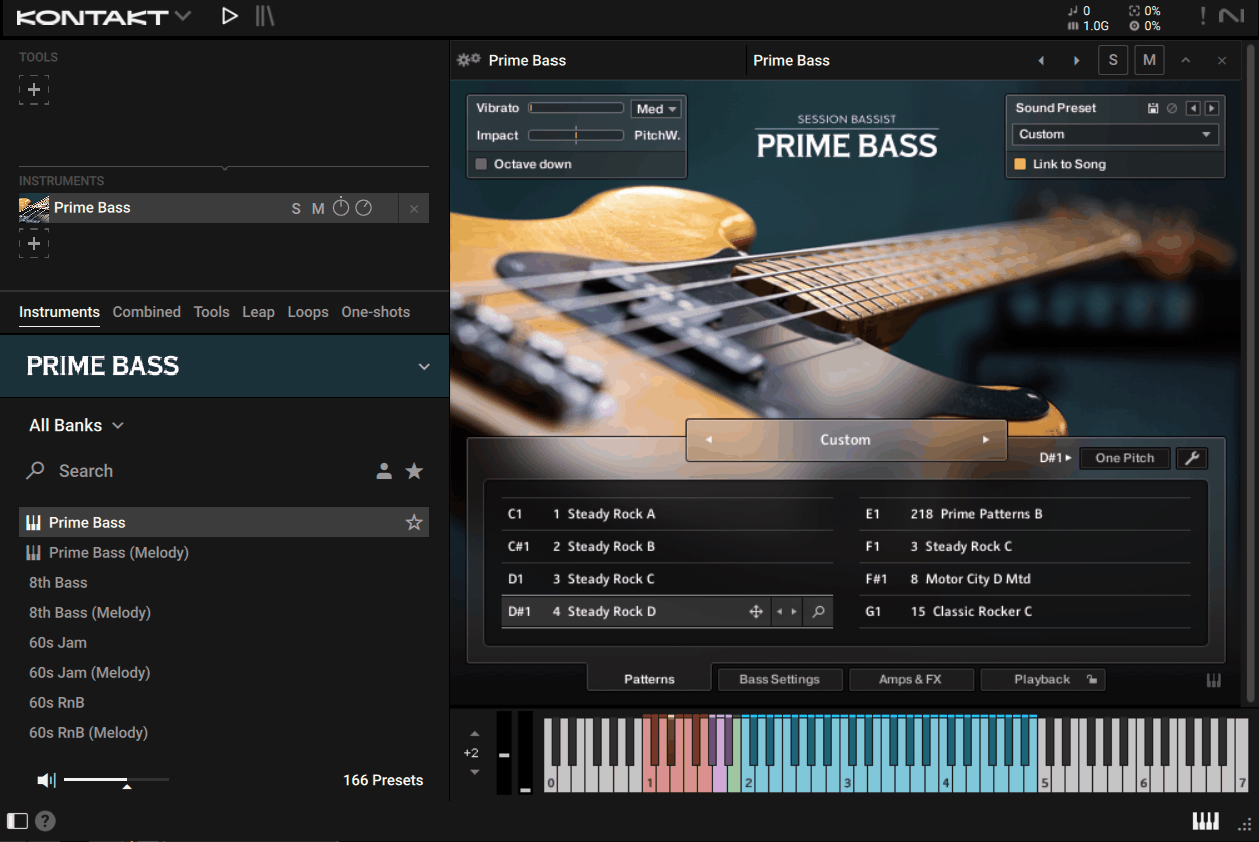
Prime Bass solves a different problem from the deeply customizable libraries above.
Instead of expecting you to program every detail of a bass performance, it gives you a large collection of played patterns and then handles many of the small performance details automatically.
It is particularly convincing for 70s-style parts and song-driven arrangements where the groove matters more than absolute control over every individual note. It is sampled from an original 1981 cherry sunburst Fender Precision Bass, with 350-plus patterns across 81 song presets, plus a separate melody instrument for your own lines.
- 350+ Patterns Across 81 Songs
The pattern library gives you a large selection of played grooves across different styles, and you can drag the MIDI into your DAW when you want to edit the part yourself.
That makes Prime Bass a useful writing tool even if the final performance is going to be heavily customized.
- Two Instruments in One
The rhythm patch handles the pattern-based performance, while the separate melody instrument gives you more direct control over your own basslines.
That second instrument is particularly useful when the song needs a fill, turnaround, or custom phrase that does not exist in the pattern library.
- Amp and Cabinet Section
Two guitar amps and 13 cabinets are joined by the Bass Invader and Bass Pro bass amp additions, with transformer and tube saturation available for extra character.
There is enough here to move from a basic pattern to a recognizable finished bass tone without having to start from scratch.
8. Ample Bass JF
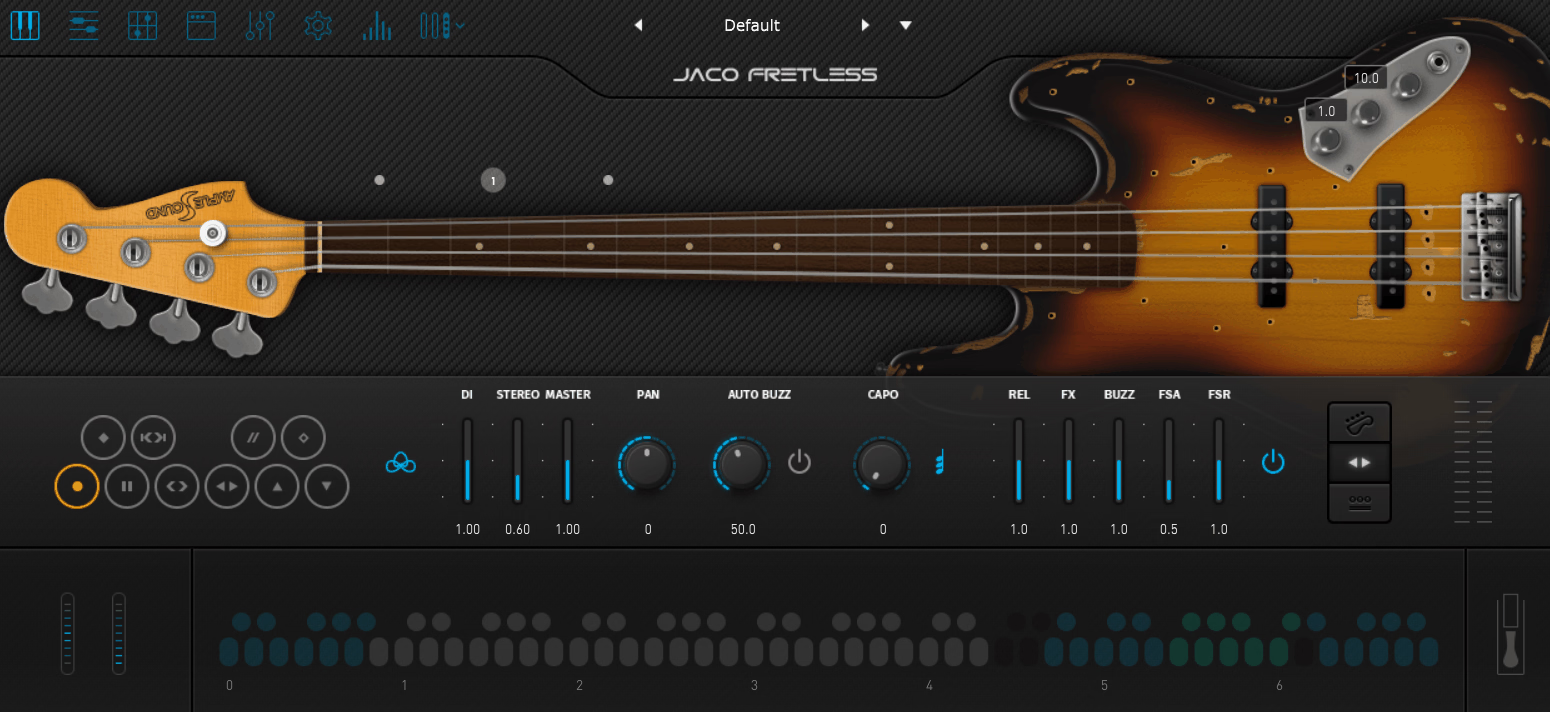
Ample Bass JF focuses on a very different performance challenge: fretless bass.
It is sampled from a Fender Custom Shop Jaco Pastorius Relic Fretless Jazz Bass, and the central reason to choose it is the polyphonic legato and slide system built specifically around fretless playing.
That makes it a much more specialized instrument than Ample Bass J or Ample Bass P. I would reach for it when the expressive slide and legato behavior are part of the sound, rather than simply because I want another Jazz Bass.
- 13 Articulations
The articulation set includes sustain, palm mute, slides, slap, pop, tap, artificial harmonic, accentuated, repeat note, and dead notes.
That gives you plenty of room for conventional phrases while still covering the expressive techniques associated with fretless playing.
- Polyphonic Legato and Slide System
The polyphonic legato system is designed to produce realistic glides across intervals and playing speeds.
This is where the library earns its place. On a slow, exposed melodic line, the difference between an ordinary pitch transition and a convincing fretless slide is obvious.
- Amp and Cabinet Section
Three bass amp heads—B15R, BA500, and SVT-Pro—can be routed through four cabinet choices, with four microphone types available for each.
That is enough tonal variety to cover everything from warm, rounded fretless parts to more assertive tones without immediately reaching for external processing.
9. Shreddage 3 Abyss
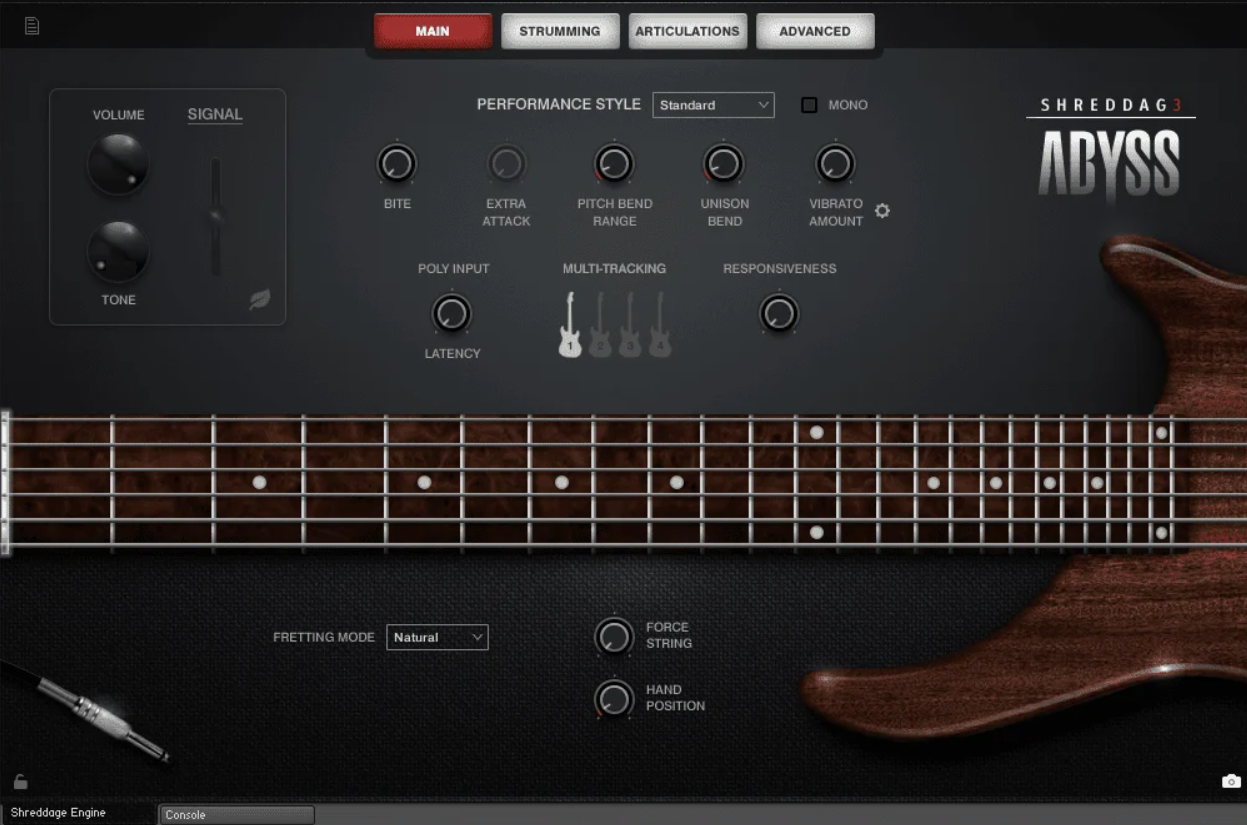
Shreddage 3 Abyss is designed for players who need a modern extended-range bass rather than a vintage instrument.
It is based around a custom Muckelroy six-string tuned to drop A, and the library is focused on keeping the low register usable without turning the instrument into a one-purpose sub-bass machine.
The recording was performed by bassist Tony Dickinson through a Universal Audio Solo/610 analog tube preamp DI, with more than 10,000 24-bit samples, up to eight round robins, and four dynamic layers per note.
That depth is particularly valuable when repeated notes are exposed and you do not want the same sample appearing over and over.
- Drop A Six-String Range
The custom six-string extends down to drop A and covers approximately four and a half octaves. That gives you enough range for very low rhythm parts without sacrificing the higher register needed for melodic or lead-style playing.
- 10,000+ Samples
The library includes sustains, staccatos, pops, tapping, harmonics, slides, hammer-ons, and pull-offs across up to eight round robins and four dynamic layers.
The practical advantage is variation. The deeper the sample pool, the easier it is to avoid the obvious repeating-note effect that can make programmed bass sound artificial.
- Pickup Blending
- Console FX Rack
The built-in Console includes more than 30 effects modules, including EQs, compressors, modulation, reverbs, amps, and distortion, plus more than 30 custom cabinet IRs. That gives you a large amount of tonal flexibility from a DI-oriented starting point.
10. NI Session Bassist Jam Bass
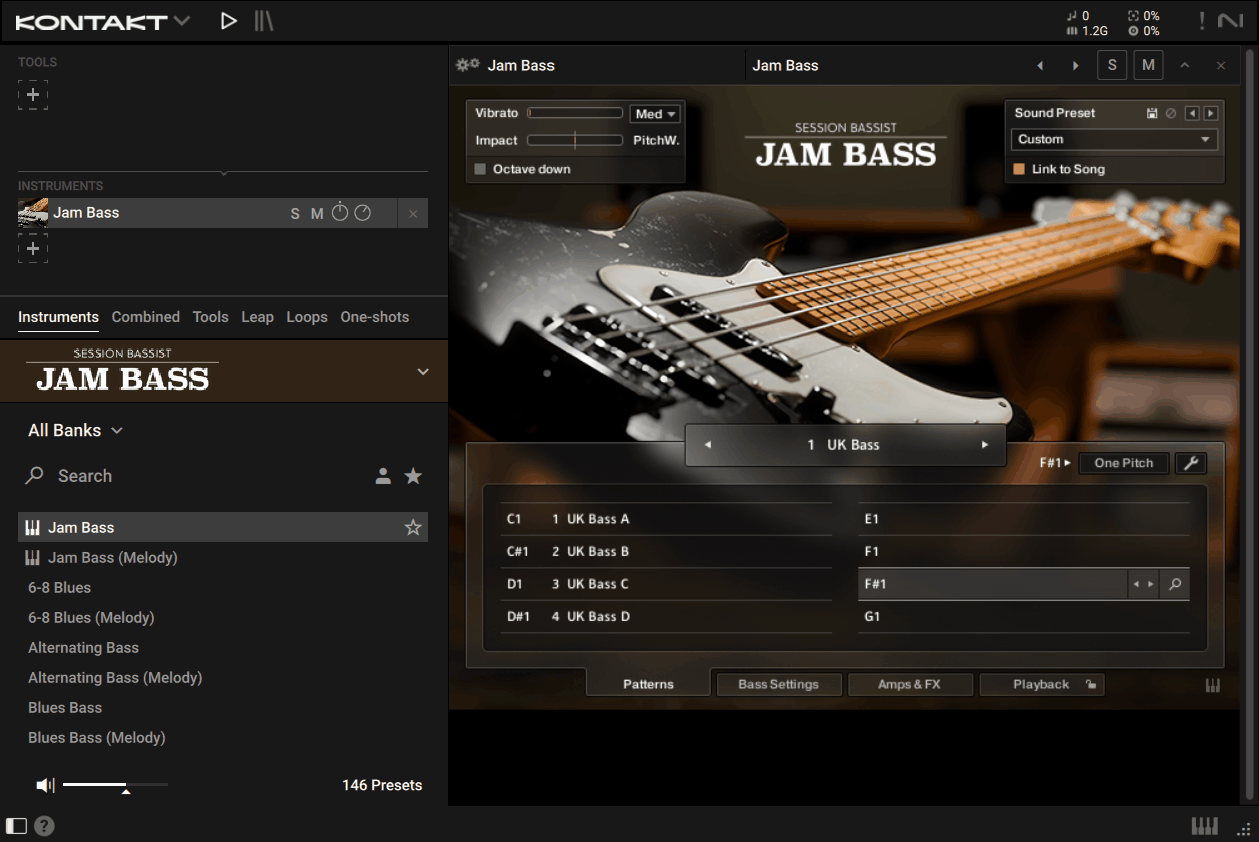
I think the most useful way to understand Jam Bass is as a groove-first instrument.
It is built around a USA-made offset-body bass with dual passive single-coils, so you can move from a rounded neck sound to a brighter bridge character without leaving the instrument.
The library includes 283 patterns across 71 songs, plus a separate melody instrument for custom lines.
What makes it useful is not simply the number of patterns. It is the ability to use those patterns as a performance starting point and then customize the result once you know where the track is going.
- Dual Single-Coil Pickup Blend
The neck and bridge pickups can be blended continuously.
That gives you more tonal range than simply choosing between two fixed pickup presets, particularly when you are trying to make a part sit differently in a dense mix.
- 283 Patterns Across 71 Songs
The pattern library covers grooves ranging from funk and rock to jazz, with MIDI drag-and-drop available when you want to edit a part in the DAW.
I would browse these by feel rather than by genre label. The groove itself matters more than the category attached to it.
- Guitar Rig 7 Pro Effects
The instrument includes 54 sound presets and access to the Guitar Rig 7 Pro effects set.
That gives you a straightforward path from a clean pattern to anything from a rounded vintage sound to something more aggressive and processed.
11. Ample Bass TR6
A four-string bass is enough for most productions. The reason to choose Ample Bass TR6 is that you specifically want more range.
It is built around a Yamaha TRBJP2, the signature six-string bass associated with John Patitucci, and that extra range gives you room to move both lower and higher without switching instruments.
That makes it particularly interesting for fusion, progressive music, and parts that move between bass and more melodic territory.
- 14 Articulations
The instrument covers sustain, palm mute, natural harmonic, hammer-on and pull-off, legato slide, slide in and out, slap, pop, tap, full slide, mordent, and arpeggio.
The arpeggio and extended articulation set make this more flexible than a library designed purely for conventional rhythm bass.
- 7.5 GB Sample Library
A 7.5 GB multisample library captures a large amount of the instrument’s playing detail, including fingering noise from the original sessions. That extra detail is most useful on exposed passages where the bass has enough space in the arrangement for those subtle noises to remain audible.
- Riffer 4 and Tab Reader
Riffer 4 handles MIDI programming and chord or strumming ideas, while Tab Reader can import tablature for playback or export. Those tools make the library useful as more than a sample player when you are building more involved bass parts.
12. NI Session Bassist Icon Bass
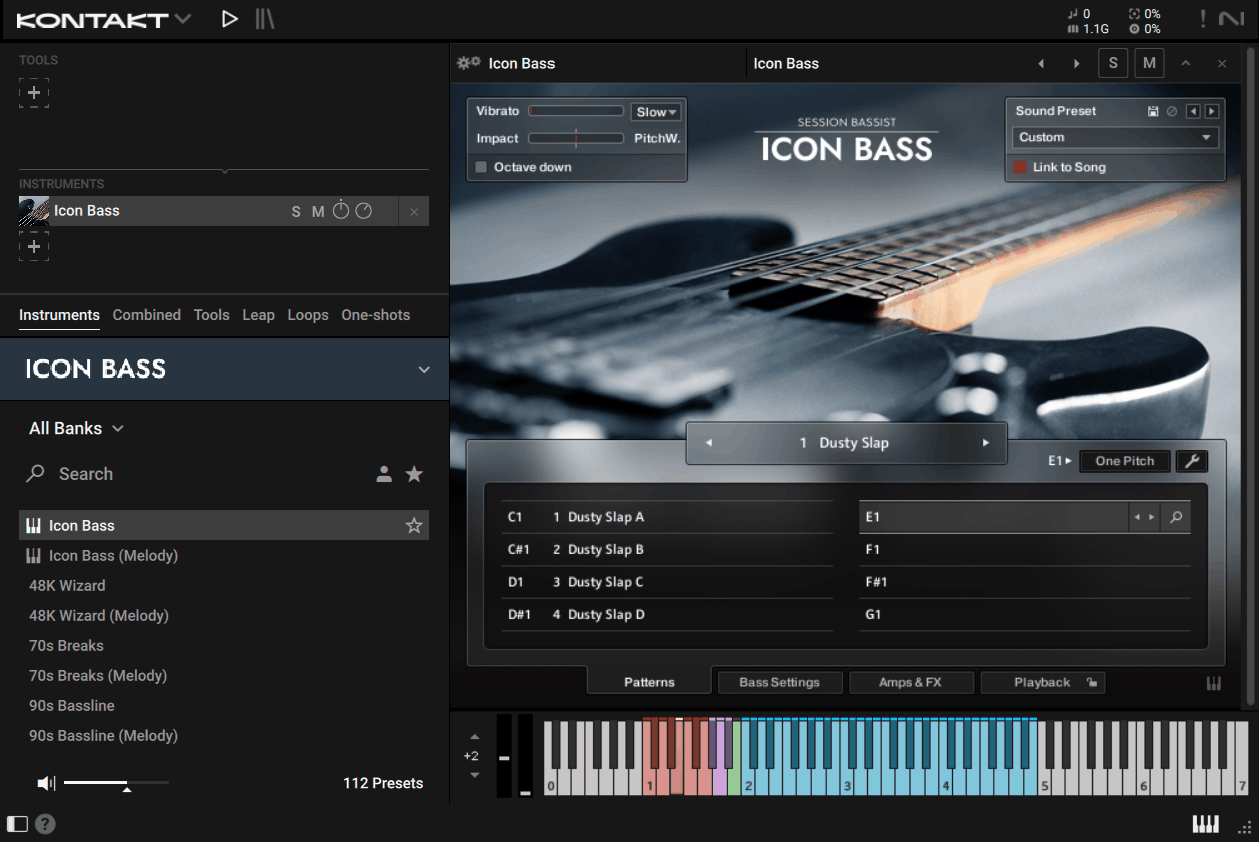
Icon Bass is aimed at the kind of bass part that has to push through the arrangement.
It is the first Session Bassist instrument in this collection built around active electronics, making it a natural choice for harder rock, aggressive funk, and pop parts that need more bite and headroom.
The instrument is sampled from a 1989 USA-made solid-body bass, with an active 9V-powered DI signal captured through a vintage Universal Audio M-610 preamp, alongside two vintage dynamic microphones.
- Active Electronics
The active design gives Icon Bass a more forceful response than you would normally expect from a passive instrument. That extra bite makes it easier to keep the bass audible when guitars, synths, and drums are all competing for space.
- 200+ Patterns and Phrases
The library includes more than 200 patterns and phrases performed by session bassists.
I would think of these as both production material and arrangement inspiration. Sometimes the fastest way to improve a bass part is to hear a different groove rather than spend another 20 minutes editing the existing one.
- Dual Microphone Signal Chain
An AEA R84 ribbon microphone through a Neve 1073 preamp is combined with an Avantone CV-28 tube condenser.
That gives you multiple source characters to blend instead of forcing every part through the same fixed microphone sound.
Freebies:
1. Ample Bass P II Lite
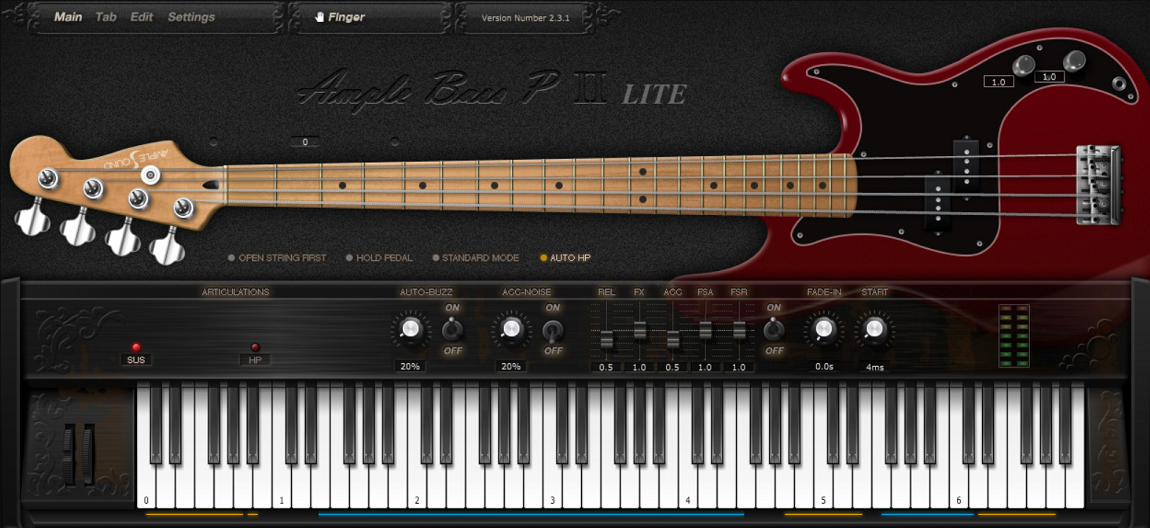
Ample Bass P II Lite is one of the more useful free options because it does not feel like a token demo of a paid instrument.
It is based around the Fingerstyle 1 library and includes five core articulations that cover most of what a basic Precision Bass part needs. You also get Riffer 4, Tab Reader 4, drop tuning down to D1, and an onboard amp and effects section.
For a free bass instrument, that is a substantial amount of functionality.
- Fingerstyle 1 Library
The library includes sustain, hammer-on and pull-off, legato slide, palm mute, and accent.
Those five articulations are enough to cover a surprisingly large number of conventional bass parts, especially when the arrangement does not require specialist techniques.
- Riffer 4 and Tab Reader 4
The MIDI editor and tablature reader are included rather than being stripped out of the free version. That means the workflow is much closer to the paid instrument than you might expect.
- Auto Buzz System
The Auto Buzz feature adds natural string-to-fret noise automatically. Those small bits of physical noise can make a programmed bassline feel less sterile.
- Capo Logic
Automatic fingering logic adapts to the performance context so the instrument can make more realistic choices about string and fret positions.
2. Shreddage 3 Precision FREE
Free bass plugins often compromise either the sample quality or the range of available techniques. Shreddage 3 Precision FREE makes a narrower compromise: range.
It gives you two playable octaves instead of the full version’s three and a half, but the material inside that range comes from the same recording session, with the same sample quality and performance detail. That makes it a more useful free option than one that sounds fine for a few notes and falls apart outside a narrow range.
It was performed by bassist Tony Dickinson on a 5-string flatwound P-bass, recorded through an all-analog UA|610 DI, with fingerstyle sustains, popping, and release noises included.
- Two-Octave Range
The main restriction is the playable range.
Two octaves is enough for many ordinary bass parts, but you will notice the limitation once the arrangement needs a wider register.
- Same Sample Quality as the Paid Version
The free instrument uses the same underlying recording quality as the paid version for the notes that are available. That means you are not simply getting a lower-quality substitute because the instrument costs nothing.
- Console FX Rack
The full modular Console effects rack is included, with EQ, compression, reverb, and other processing options. That makes it easier to turn the free DI signal into a usable finished sound without immediately reaching for a separate effects chain.
- Four Dynamic Layers
The instrument includes four dynamic layers and four round-robin variations per note.
That is enough variation to keep repeated phrases from sounding obviously recycled, which is one of the first things that tends to expose a basic sampled bass.
Hey, I’m Vil, I started this site to help you find the best audio plugins covering various categories including synths, pianos, strings, and effect tools of all sorts as well. I pick these plugins based on various criteria so it best matches the actual topic.