When you purchase through the links on my site, you support the site at no extra cost to you. Here is how it works.
Deelay came out of a collaboration between Sixth Sample and Integraudio, built as a creative project rather than a commercial product designed to compete directly with established delay tools. That context shapes what it is and what it isn’t.
It’s a stereo delay plugin with a visual, approachable interface and a focus on making creative delay sounds accessible without a steep learning curve. The question worth asking isn’t whether it does everything, it’s whether what it does sounds good and fits naturally into the way you work.
What makes it different
Most delay plugins ask you to think in terms of signal flow: input, feedback, filtering, output. Deelay organizes things around the sound itself rather than the technical chain, which makes it faster to get somewhere interesting without necessarily understanding every parameter underneath.
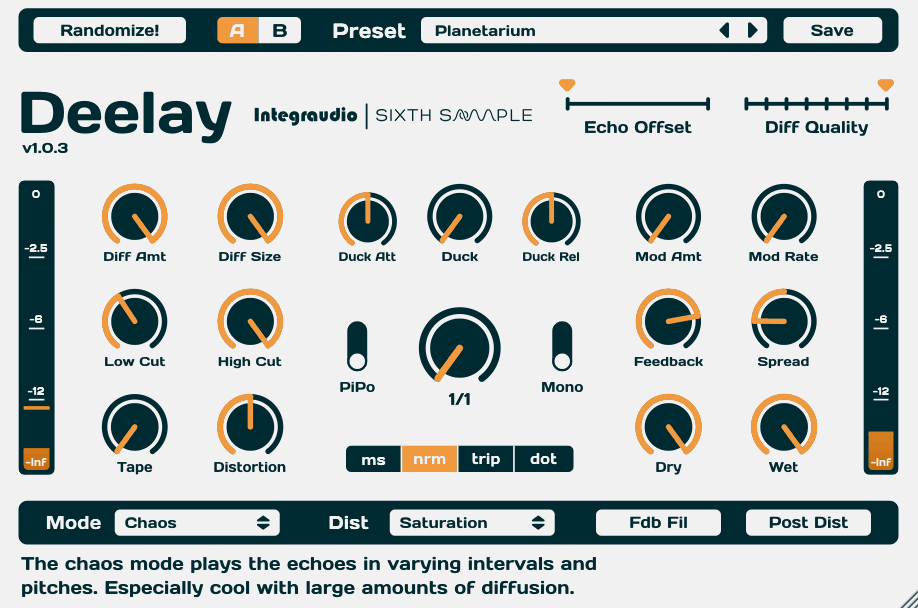
The visual feedback is a genuine part of the workflow, not just decoration.
The display shows you how the delay is behaving in a way that makes it easier to understand what’s happening to the signal, and I found that particularly useful when working with more complex modulation settings where the relationship between rate, depth, and feedback can get hard to predict by ear alone.
What it brings sonically is a warmth and softness in the repeats that sits closer to tape delay behavior than a clean digital echo. The trails don’t feel clinical. They decay in a way that tends to sit behind the dry signal naturally without needing a lot of EQ adjustment to make the repeats feel like they belong in the mix.
Here’s what you’re actually working with at the core:
- Stereo delay engine with independent left and right channel control
- Modulation section covering rate and depth for pitch and time variation in the repeats
- Feedback control that moves from clean slapback territory into self-oscillation as you push it
- Stereo width control for spreading repeats independently of the dry signal
- Visual display showing delay behavior in real time as you adjust parameters
The sound and where it lives in a mix
The repeats have a natural high-frequency rolloff that gives Deelay its main character. Each echo is slightly darker and softer than the one before it, which means the delay tail integrates into a mix without competing with the dry signal for the same frequency space.
I find this genuinely useful on vocals and leads where a brighter, cleaner delay tends to clutter the top end of a mix after a few repeats.
On vocals specifically, Deelay earns its place quickly. The softness of the repeats suits the natural decay of a voice in a way that cleaner digital delays don’t always manage, and the modulation controls add just enough pitch movement to the tails to make them feel alive without the obvious wobble of a heavy chorus effect.
- Modulation depth and rate
The modulation section controls how much pitch and time variation gets applied to the repeats as they decay. At low settings it adds a subtle, almost imperceptible movement that keeps the tails from feeling static.
Push it further and the effect becomes more pronounced, introducing a vintage tape-style instability that works well on guitars, pads, and anything where some looseness in the repeats adds character rather than distraction.
The useful range for most mixing applications sits at the lower end of the modulation depth control. The difference between “warm and organic” and “noticeably wobbly” is a smaller adjustment than you might expect, so start lower than feels intuitive and move up gradually rather than dialing in something obvious and pulling it back.
- Feedback and tail behavior
Feedback behaves predictably up to moderate values and then builds resonance faster than some delay plugins as you push it higher. For creative sound design purposes that rapid buildup can be useful. For mixing applications where you want long repeating tails without resonance, keeping feedback below the halfway point is the more reliable approach.
- Stereo width control
The stereo controls let you spread the repeats across the field independently of the dry signal, which is useful on sources that need to stay centered while the delay creates width around them. On a lead synth or a guitar part, spreading the repeats while keeping the dry signal narrow gives you a sense of space without losing the focus of the original sound.
Where it becomes a limitation
Deelay is a character-driven delay, and that’s also the thing that limits where you can use it. The warmth and softness of the repeats that make it sound good on vocals and organic material make it less useful when you need clean, precise digital echoes with full-frequency repeats. On electronic material where the delay is meant to be heard clearly as a rhythmic element rather than felt as ambience, the natural rolloff works against you.
It’s also not the deepest tool for complex rhythmic delay patterns. You’re not getting multi-tap routing, per-tap filtering, or a deep modulation matrix that something like Valhalla Delay or Eventide’s delay plugins offer.
The simplicity that makes Deelay approachable is the same thing that puts a ceiling on how far you can push it technically.
Where it struggles most:
- Tempo-synced rhythmic work on electronic music where clean, precise repeats matter more than warmth
- Multi-tap delay patterns where you need independent control over each repeat’s character
- Full-frequency delay tails where the natural high-frequency rolloff removes too much presence from the repeats
- Complex modulation routing that goes beyond the built-in rate and depth controls
Worth the hype?
The hype around Integraudio & Sixth Sample Deelay tends to center on how good it sounds on organic material, and that reputation is earned. On vocals, guitars, acoustic instruments, and pads, the warm repeats and subtle modulation do exactly what good delay should do in a mix: add depth and space without drawing attention to themselves.
The hype is less deserved when it gets presented as a versatile all-purpose delay, because it isn’t one. It has a specific sound and a specific range of applications where that sound works, and outside of that range you’ll find yourself reaching for something else.
Deelay is completely free, which makes the question of whether it’s worth it almost redundant. The more useful question is whether it fits what you actually make. If you work regularly with vocals, live instruments, or any material where a warm, softly modulated delay tail is what you’re after, download it without thinking twice.
If your sessions are primarily electronic and you need rhythmic precision over character, it’s still worth having in your toolkit at no cost, even if it won’t be your first reach for those kinds of sessions.

Hey, I’m Vil, I started this site to help you find the best audio plugins covering various categories including synths, pianos, strings, and effect tools of all sorts as well. I pick these plugins based on various criteria so it best matches the actual topic.