When you purchase through the links on my site, you support the site at no extra cost to you. Here is how it works.
Piano plugins tend to fall into two camps. Some recreate the instrument through real-time physical modeling, while others rely on deep sampling to capture a particular piano, room, microphone setup, and even the small noises that make the instrument feel alive.
I wouldn’t choose between them simply by asking which one sounds most realistic on its own. The more useful question is what kind of piano you actually need: something you can reshape in detail, something that already sits beautifully in a mix, or a specific instrument with a character you keep coming back to.
That’s why this list covers both approaches. Some of these plugins give you unusual control over the instrument itself, while others are more about choosing the right piano, microphone perspective, or room and getting straight to the sound.
I picked them because each one solves a slightly different problem, and because the differences become much easier to hear once you stop comparing them as if they’re all trying to do the same thing.
1. Modartt Pianoteq 9 Standard
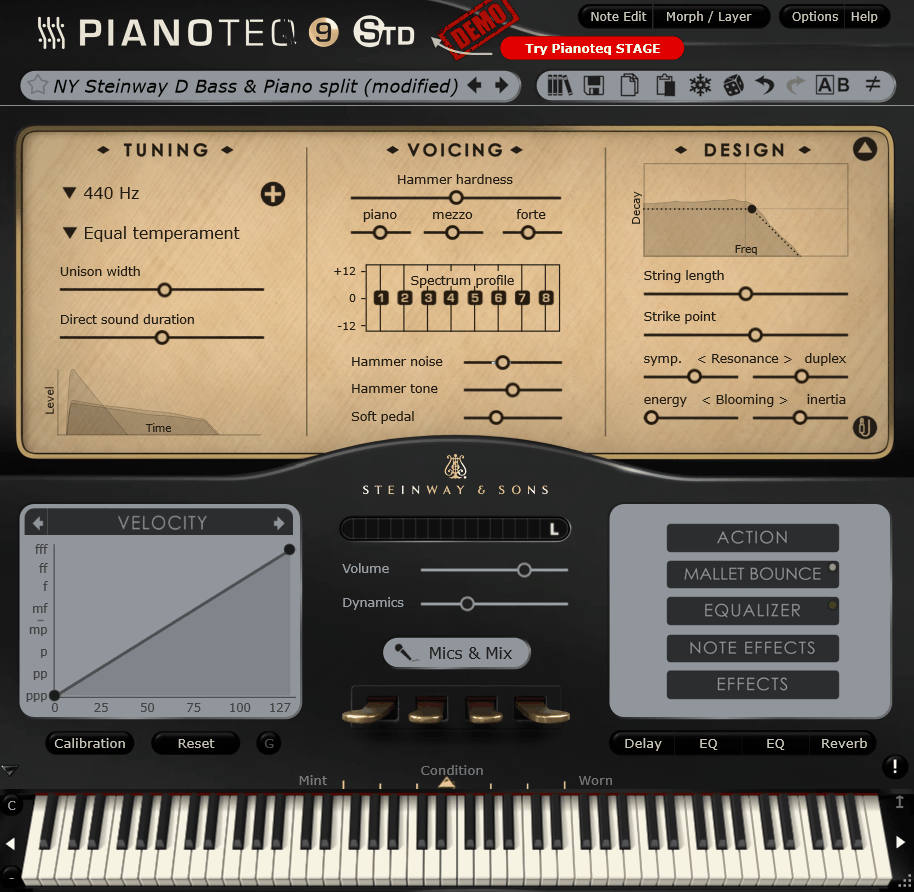
Pianoteq takes the opposite approach to a traditional sampled piano. Instead of playing back recordings of every note and articulation, Modartt Pianoteq 9 Standard calculates the sound in real time using a physical model.
That difference matters less as a technical novelty than it does in practice. You can change physical characteristics of the instrument while you play, and the piano can behave more like a system you are shaping than a fixed recording you are selecting.
The Standard edition includes instrument packs, and virtual versions of concert grands associated with names such as Steinway & Sons, Bechstein, Blüthner, Grotrian, Petrof, and Steingraeber are available across the Pianoteq ecosystem.
Version 9 also revoiced the grands around an improved soundboard model, with the change particularly noticeable in the upper register. The one thing I would not judge Pianoteq by too quickly is its stock presets.
Some are intentionally more synthetic, and the instrument can show a much wider range once you start working with its deeper controls.
- Eight Microphone Positions
Pianoteq lets you place up to eight modeled microphones in 3D space, choose between modeled microphone types, and combine the results in a mixer with independent delay per microphone and channel. That is one of the biggest practical advantages of the modeling approach.
If a close mic is giving you too much hammer attack, you don’t have to accept that perspective or search for another sampled version of the same piano. You can simply move the microphone.
For me, that kind of control is more valuable than having another hundred presets.
- Physical Parameters
Controls for unison width, hammer hardness, soundboard resonance, microtuning, and string length let you reshape the instrument itself. You can even stretch the modeled string length from a 1 m mini grand toward an imaginary 10 m instrument.
That’s not just a gimmick. It shows why Pianoteq is useful when you want to move away from a fixed, historically captured piano and start designing the behavior of the instrument.
- Morphing and Layering
You can blend two instruments at the modeling level and also layer them across the keyboard.
- Binaural Head Mode
For headphone users, the Binaural Head mode is worth trying. A virtual head can be positioned and rotated around the piano, giving you another way to shape the stereo perspective.
Best for
Pianoteq makes the most sense when you want deep control, flexible sound design, and the ability to change the behavior of the piano itself rather than choosing between fixed samples.
2. Roland EARTH Piano
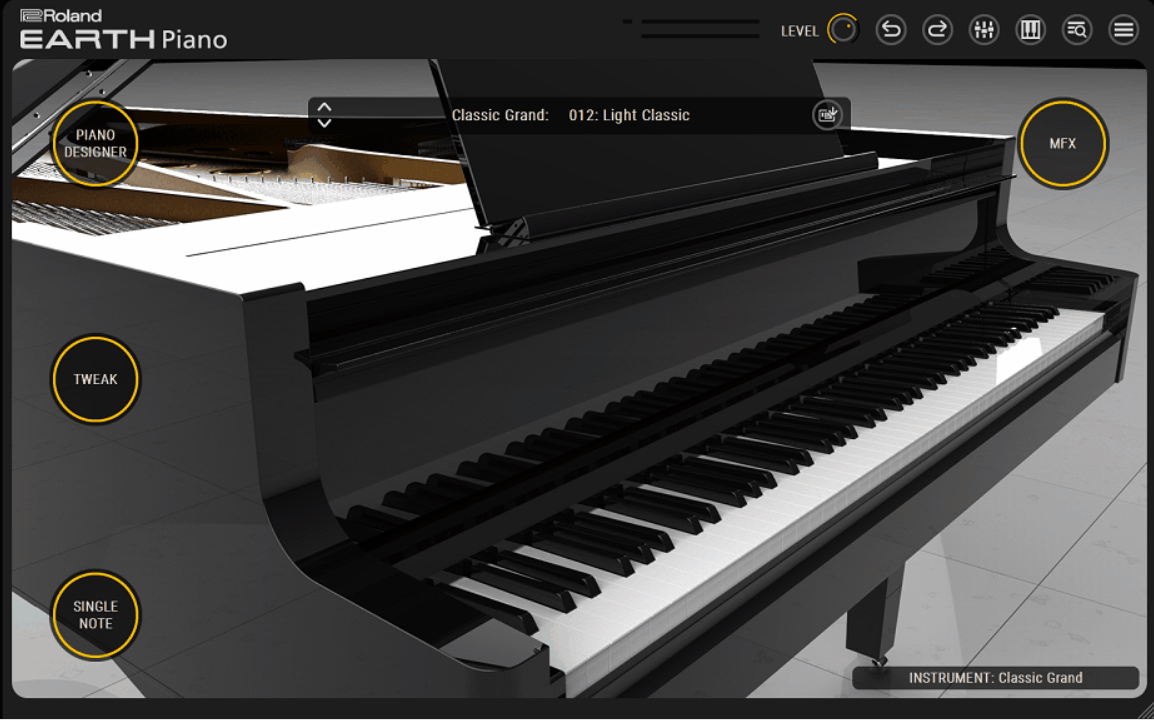
Roland EARTH Piano gives you seven piano models, including Classic Grand, Session Grand, Artist Grand, Natural Upright, Natural Felt Upright, Toy Piano, and All Silver, a more unusual instrument built around the idea of a piano strung entirely with silver strings.
What I like about the collection is the range. You are not getting seven slightly different concert grands; you can move from a conventional grand to upright, felt, toy, and deliberately unusual sounds without leaving the same instrument.
The main thing I would test early is the velocity curve. There is no page that lets you redraw it, so the way your MIDI controller already responds at low velocities becomes important.
If your playing depends heavily on very fine dynamic control, I would check that before you get too attached to the sound.
- Venue Convolution Spaces
The Venue section gives you nine spaces based on real locations, from a cathedral to a small lounge, and you can move the listening position inside the room through the visual display. That’s useful because the room is doing more than simply adding reverb.
Moving the listening position changes how close or distant the piano feels, which can be a much faster way to find the right depth than building a separate reverb chain from scratch. I would start there before reaching for another reverb plugin.
- Resonance Controls
You can adjust string, cabinet, key-off, and sympathetic resonances for each piano type individually. That becomes especially useful on the Natural Felt Upright, where pulling the cabinet resonance back can leave more room for the softer felt character to come through.
The important part is that you’re not locked into one factory balance for those physical details.
- ZENOLOGY FX Multi-Effects
The plugin includes 93 ZENOLOGY FX multi-effects presets, plus a three-band EQ and compressor modes including FET, optical, and VCA. The effects give you plenty of room to experiment, but I find the compressor modes more immediately practical.
The optical setting, for example, can help control transients without making the piano’s decay feel unnecessarily flat.
Best for
I would look at EARTH Piano if you want variety, detailed per-piano control, and a piano that can move beyond straightforward acoustic realism.
3. Spectrasonics Keyscape
Spectrasonics Keyscape takes the opposite route again. Instead of building the piano mathematically, it focuses on finding distinctive instruments, restoring them properly, and sampling them in detail.
The collection includes 36 instruments, several more than a century old, with extensive restoration work behind them. The result is a large library with over 500 sounds, and the full installation sits at roughly 77 GB.
You get:
- LA Custom C7 Grand
The LA Custom C7 Grand is probably the easiest place to understand why the library is popular. It was fitted with vintage hammer felts and voiced around warmth at low velocities with more bite as you play harder.
For pop, R&B, and dense production, that kind of voicing can be very practical because the piano can stay present without forcing you to carve large amounts of space with EQ
- Hybrid Duo Sounds
The Duo patches combine two instruments into a single playable sound. The advantage is obvious once you use them: you can get timbres that neither source produces alone, without building and balancing the combination manually.
- Imperfections Kept In
Keyscape keeps mechanical noises, pedal noises, and release overtones rather than stripping every non-musical sound out of the recordings. Those details matter because they tell your ear that you’re hearing an instrument behaving physically, not just a sequence of perfectly isolated samples.
- Modeled Amps and Effects
The electric pianos also include modeled versions of the vintage amplifiers and classic effects chains associated with those instruments. That saves time, but more importantly, it means the character of the keyboard and the character of the signal path arrive together.
- Keyscape Creative
When you also own Omnisphere, Keyscape opens up a separate library of more than 1,500 patches built from Keyscape sounds and processed through Omnisphere’s synthesis engine
- Lighter Install Option
There is also a 30 GB installation option. That is the version I would look at for a laptop or smaller drive when the full collection is more space than you actually need.
Best for
Keyscape is especially compelling if you want distinctive instruments, mix-friendly presets, and a library that goes well beyond the conventional concert grand.
4. XLN Audio Addictive Keys
The strength of this piano is that it can get you to a useful musical sound quickly.
That matters more than it sounds. For exposed classical writing, I would still look toward a deeper sampled instrument, but for pop, house, songwriting, and production work, Addictive Keys is often more practical because the library is focused, the interface is approachable, and the presets are built to get somewhere useful without much setup.
The collection includes Studio Grand, based on a Steinway Model D, Modern Upright, Mark One based on a Rhodes Mk. 1 through a MusicMan 112 RD combo, and Electric Grand based on a CP-80.
- Seven Mic Perspectives
The Modern Upright gives you seven microphone positions spanning close and far, floor and soundboard, and mono and stereo perspectives. That may look excessive at first, but it is exactly what makes one upright more flexible than you might expect.
A close perspective can keep it intimate, while a more distant or floor-oriented position can change the weight and space without forcing you to build the sound from scratch. I find the floor mic particularly useful when I want more body without simply adding low-end EQ.
- Three Signal Paths
The Electric Grand is especially flexible because you get the acoustic hammer sound, the direct output including a vintage Dim-D chorus path, and an amplified signal. Those sources can be blended rather than treated as separate instruments.
I like being able to bring some hammer sound back underneath an electric signal because it keeps the CP-80 from becoming too clean or two-dimensional.
- Vintage Microphone Selection
The Studio Grand was recorded with tube and ribbon microphones, while the Mark One amp setup includes dynamic, tube-condenser, and ribbon microphones along with floor and room perspectives. The practical advantage is that more of the tonal decision stays inside the instrument.
You can decide whether you want intimate, bright, roomy, or more characterful without immediately reaching for another processor.
Best for
I would choose Addictive Keys when speed, workflow, and mix-ready sounds matter more to you than maximum sampling depth.
5. MeldaProduction MeldwayGrand
The piano is based on a sampled Steinway D recorded at the Faculty of Music of the Academy of Performing Arts in Prague. MeldwayGrand runs inside MSoundFactory, so it takes an extra step to get started, but the added controls give you more options than a standard sampled piano.
The Creative tab lets you process the piano with resonators, filters, and FM, and you can change the order of the effects. That makes it useful when you want to push the piano into more processed sounds instead of keeping it strictly natural.
For a straightforward piano sound, the extra setup is not ideal. The main reason to use it is the added sound-design flexibility.
- Seven Stereo Microphone Pairs
You get seven stereo pairs covering several perspectives, including a centered pair, a head mic, ultra-close pairs, a ball mic inside the piano, Brauner microphones, and a ground pair. Each microphone also gives you control over volume, formants, and detuning.
That makes the mic system more than a choice of distance. You can deliberately thicken or reshape the stereo character by changing how the pairs relate to each other. A small amount of detuning between pairs can add body without relying on another chorus or reverb plugin.
- Sympathetic Resonance Without Sustain
You can trigger sympathetic resonances even with the sustain pedal up and send those resonances through reverb separately. That gives you an interesting way to make a piano bloom around the notes without making the notes themselves wetter.
For ambient or cinematic parts, I find that more useful than simply increasing the main piano reverb.
- Partial Sustain Pedal
MeldwayGrand supports half pedaling, so continuous pedal information from a compatible controller can create more gradual variation instead of an all-or-nothing sustain response. This matters most if you already play with a proper piano pedal and care about how the sustain behaves under your foot.
- 25 Algorithmic Reverbs
The FX section includes 25 reverb algorithms, along with delay, a sonic enhancer, and a compressor. I tend to prefer the shorter reverbs here and let the microphone blend provide most of the size.
The advantage is that the space can remain closely tied to the instrument instead of becoming an obvious effect added after the fact.
- EZ Edition Included
MeldwayGrand EZ simplifies the microphone options and comes included with the license. I would keep that version on a travel machine when drive space matters more than having every possible microphone control available.
Best for
MeldwayGrand is a strong choice when you want a realistic grand with unusually deep microphone control and enough creative processing to turn the piano into a sound-design instrument.
6. VI Labs Audio Ravenscroft 275
This piano is built from a large set of recordings of the original acoustic instrument rather than physical modeling. It uses 19 velocity layers and nearly 17,000 samples, giving it plenty of recorded variation across different playing levels. VI Labs Audio Ravenscroft 275 is a good fit when you want a sampled piano that keeps the character of the original instrument intact.
The piano was built by hand in Scottsdale, Arizona, with a Sitka spruce soundboard and solid titanium string termination points. Those details are part of the original instrument, but the more noticeable difference is how the notes sound and behave as they fade out.
The sustain and bloom are especially convincing, giving held notes a more natural decay instead of sounding like a static sample.
- Four Mic Perspectives
The main perspectives are Close, Player, Side, and Room. Close focuses more directly on the strings and hammers.
Player gives you the perspective from the keys. Side uses a mid-side U87 setup, while Room captures more of the surrounding space. You can deactivate a microphone without unloading its samples, so you can manage polyphony without waiting for the instrument to reload.
That is a small workflow detail, but it matters once you’re actually using the piano inside a project.
- True Pedal Action
Pedal resonance responds to the actual movement of the pedal, so quickly lifting and pressing again can trigger another resonance at a lower volume. This is one of those features that sounds technical until you play it.
Under your fingers and foot, the sustain simply feels more responsive.
- Half Pedal Samples
Half pedaling is sample-based, with the CC range adjustable to match your pedal. I would set that up before judging the instrument because the release behavior can change quite a lot depending on how your controller is calibrated.
- Sampled Una Corda
The soft pedal uses a separate sample set with more than a thousand release samples. That gives you another way to get a softer, mellower contact when simply playing more quietly doesn’t quite provide the character you want.
- Muted and Silent Strikes
Muted Strikes give you multi-velocity samples of damped notes, while Silent Strikes capture the very quiet sound of a key being pressed without reaching the strings. Both can be triggered live, including through modulation or pedal control.
Those details are especially useful when the goal is realism at low levels, where a normal piano sample can otherwise become unnaturally clean.
- Timbre Shift and Reverbs
Timbre Shift changes the perceived brightness or darkness by shifting the samples’ root pitch, which can feel more dramatic than ordinary EQ. You also get 22 convolution reverbs, ranging from smaller spaces to large cathedral-style environments.
Best for
Ravenscroft 275 is the one I would look toward when pedal response, natural decay, and an expressive concert-grand feel matter more than having endless editing options.
7. EastWest Pianos Platinum
EastWest Pianos Platinum gives you four concert grands: Steinway D, Bösendorfer 290, Bechstein 280, and Yamaha C7. Each piano has three microphone positions, with around 60 GB of samples per instrument and up to 18 velocities per note for each articulation.
This is a serious library, and I would treat it that way from the beginning. The computer requirements are part of the decision, not a footnote.
The recommended specification is an eight-core CPU with 32 GB of RAM, and the ability to load only the microphone positions you actually need is important for keeping the instrument manageable.
- Three Mic Positions Per Piano
Each piano gives you three microphone perspectives that can be mixed. The close microphones were engineered by Ken Scott, with recording through vintage Neumann microphones, Meitner converters, and an 8078 Neve console.
What matters in practice is that those choices give the pianos a strongly recorded, finished character. I hear the difference particularly in the low mids, where the sound can feel thicker than a very clean modern capture.
- Seven Articulations
The library includes sustain, sustain with pedal, repetitions, repetitions with pedal, soft pedal, soft pedal with sustain pedal, and staccato. The repetition articulations are particularly useful for faster playing because repeated notes don’t have to sound like the same sample simply being triggered again and again.
It’s a small distinction on paper that becomes much easier to appreciate once you actually play a quick passage.
- Bösendorfer Extended Range
The Bösendorfer 290 adds nine notes below bottom A. Even if you’re working with the standard 88-key range, those additional strings contribute to the resonance of the instrument.
That makes the Bösendorfer an obvious option when the piano needs more weight underneath an arrangement.
- Bechstein Note Separation
The Bechstein 280 was voiced thinner than the other pianos. That gives it a clearer sense of separation when you’re playing or layering large chords and don’t want the sound to become dense too quickly.
- Shared Impulse Responses
The player also includes the same impulse responses used for Symphonic Orchestra and Symphonic Choirs. That is useful when you are already working inside those libraries and want the piano to occupy the same kind of environment without having to recreate the room from scratch.
Best for
EastWest Pianos Platinum makes the most sense when you want several major concert grands, multiple mic perspectives, detailed articulations, and enough depth for large, demanding arrangements, and your computer can handle it comfortably.
Extra Mention: Garritan CFX Concert Grand
The Garritan CFX Concert Grand takes a simpler approach: one Yamaha CFX, recorded in Studio One at Abbey Road, with a room that is already a major part of the sound.
You get Classic, Contemporary, and Player perspectives. I tend to stay with Classic, while Contemporary emphasizes more hammer attack and Player gives you the perspective from the bench.
The limitation is also the appeal: this is one piano rather than a broad keyboard collection. So I would choose it when you want a dedicated concert piano rather than a general-purpose keyboard library.
- Release Sample Controls
Separate release samples fire when notes are released, and you can control both Release Volume and Decay. I find that more useful than simply adding reverb because the tail already belongs to the same room as the piano.
- Sustain Resonance
Sustain Resonance controls the sympathetic ringing produced when the pedal is down. It can create a broad halo around the notes, so I would use it deliberately rather than automatically pushing it high.
- Preset Library
The included presets pair microphone choices, EQ, custom velocity curves, and convolution settings for different starting points, including darker cinematic sounds and more muted piano characters. I like using these as reference points rather than final sounds: start with the preset, then adjust the microphone balance until the piano sits where you actually need it.
Best for
Garritan CFX makes the most sense when you want one dedicated Yamaha CFX, a convincing room, and less of the complexity that comes with a broad piano collection.
Which piano plugin should you choose?
There isn’t really one winner here because these instruments are built around different priorities. Roland EARTH Piano makes the most sense when you want a wide range of piano types and the ability to fine-tune individual notes, resonance, and room placement.
Pianoteq 9 Standard is the more interesting route when you want to shape the instrument itself, from microphone position to physical parameters and unusual modeled designs. Keyscape, on the other hand, is hard to beat when you want character, vintage keyboards, and sounds that are already at home in a production rather than a concert-hall setting.
For a faster workflow, Addictive Keys is easier to live with. It gives you convincing, mix-ready sounds without asking you to spend half your session tweaking the instrument, which is exactly why I think it works so well for pop, house, and songwriting.
MeldwayGrand sits somewhere between a conventional piano and a sound-design instrument, so it becomes more appealing when microphone control and creative processing matter as much as the piano itself. Ravenscroft 275 is the one I’d lean toward for expressive playing, especially when natural sustain and pedal behavior are high on the list.
Then there’s EastWest Pianos Platinum, which is better suited to a larger setup where you want several serious concert grands and plenty of detail for demanding arrangements. And if all you really want is a beautifully recorded Yamaha CFX with a convincing room around it, Garritan CFX Concert Grand keeps things much simpler.

Hey, I’m Vil, I started this site to help you find the best audio plugins covering various categories including synths, pianos, strings, and effect tools of all sorts as well. I pick these plugins based on various criteria so it best matches the actual topic.