When you purchase through the links on my site, you support the site at no extra cost to you. Here is how it works.
BLEASS has been quietly building a catalog of mobile and desktop effects that take familiar concepts and add a modulation layer that most similar tools don’t bother with. Their Flanger is a good example of that approach. It’s not trying to reinvent the effect, but it gives you enough control over how the modulation behaves that you can use it in ways a basic flanger simply won’t allow.
The question isn’t really whether it flanges well. It’s whether the additional modulation depth justifies adding it to your setup over whatever you already have.
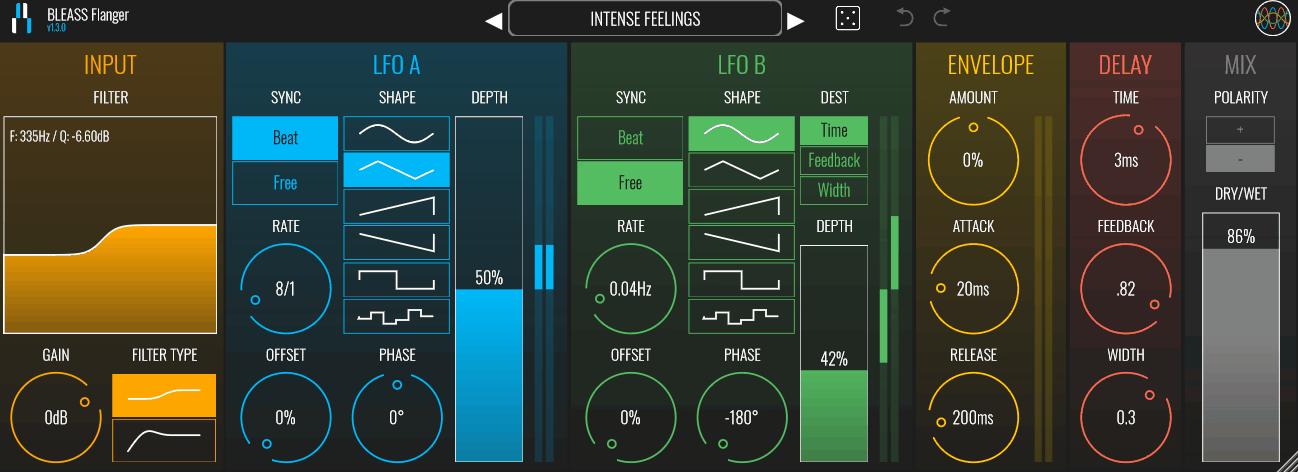
The core controls give you everything you’d expect from a flanger:
- Rate and depth control how fast and how wide the sweep moves
- Feedback shapes the resonance and harmonic character of the effect
- Delay time sets the base offset that the modulation sweeps around
- Mix balances the dry and processed signal
- LFO waveform shapes and tempo sync let the sweep lock to your track’s rhythm rather than floating freely over it
I find tempo-synced flanging considerably more useful than free-running modulation in most production contexts. A sweep that hits on the beat or subdivides against it can reinforce the rhythm of a part rather than working against it, and that’s the difference between an effect that feels intentional and one that just sounds busy.
Feedback is where a lot of the character lives in this plugin. Low feedback values give you a subtle, almost chorus-like movement. Push it higher and the resonance builds into something more metallic and aggressive. The range is wide enough that you can use the same plugin on a gentle pad and a heavily processed lead without the effect feeling like it belongs to only one of those contexts.
What the modulation system actually gives you
- Secondary modulation routing
BLEASS built a secondary modulation layer into the Flanger that lets you go beyond a single LFO driving the delay time. You can route modulation to the feedback amount and the mix level as well, which means the character and intensity of the effect can change over time without you having to draw automation in your DAW.
I find this particularly useful on sustained sounds and pads where a static effect, even a moving one, can start to feel predictable after a few bars. When the feedback is also modulating gently, the texture of the flanging shifts in a way that feels more organic than a single sweep cycling at a fixed rate.
- Stereo offset
The left and right channels can run at slightly offset modulation rates, which creates a natural-feeling stereo movement rather than the same sweep appearing identically in both ears. On a synth pad or a guitar layer, that difference is immediately audible and tends to feel more spacious than mono flanging doubled to stereo.
If you’re working on anything with width, this is the control worth spending time on. Small offset values between the two channels go a long way toward making the effect feel like it belongs to the stereo field rather than just sitting in the middle of it.
- Mix range
The mix control goes fully wet, which most flangers support, but the useful range on this one sits in the 30 to 60 percent region for most musical applications. Fully wet flanging has its place on sound design and transition effects, but for mixing purposes the balance between dry and processed signal is where the effect stays useful without becoming the only thing you hear.
Where it earns its place and where it doesn’t
On guitars, synth leads, and bass, the Flanger works well at moderate settings where the sweep adds movement without pulling the sound too far from its original character. The tempo sync makes it practical on rhythmic material because you can tie the modulation rate to the groove of the track and have the effect reinforce rather than compete with the rhythm section.
On drums and percussion, I’d be more selective. A slow flanger sweep on a drum bus can add an interesting texture on a breakdown or transition, but in a full mix it tends to blur the transient definition of the kit in a way that usually isn’t worth it. The effect is more convincing on individual elements, a snare or a hi-hat pattern, than on a complete drum mix.
Where it’s less convincing is on anything that needs to stay centered and defined in the low end. Flanging introduces phase relationships that can cause problems with mono compatibility, and on a bass part or a kick drum those problems become audible quickly. This isn’t a limitation specific to BLEASS, it’s just the nature of the effect, but it’s worth knowing before you reach for it on low-frequency sources.
Pros and cons
Pros:
- Tempo sync on the LFO makes it immediately practical on rhythmic material without manual rate matching
- Secondary modulation routing to feedback and mix level adds movement that goes beyond a single sweep
- Stereo offset between channels creates natural-feeling width rather than identical processing in both ears
- Feedback range is wide enough to cover subtle chorus-adjacent tones through to aggressive metallic resonance
- Low CPU
Cons:
- Not ideal for low-frequency sources where phase issues from flanging affect mono compatibility
- The effect has a ceiling in terms of how far you can push it before it becomes more of a sound design tool than a mixing effect, which may or may not suit what you’re after
Should you buy it?
That depends on what you’re missing. If you already have a flanger with tempo sync and secondary modulation routing, BLEASS doesn’t offer enough differentiation to justify adding another one. If your current flanger is a basic rate-and-depth affair with no modulation depth beyond the primary LFO, this is a meaningful upgrade.
BLEASS Flanger is available for around $15 to $20 depending on the platform and current pricing, which makes the decision fairly low-stakes. At that price it’s a practical tool with a genuinely useful modulation system, not a transformative purchase, but a solid one for producers who use flanging regularly and want more control over how the effect moves.
I’d say download the trial first if one is available, run it on a few different source types, and pay attention specifically to what the secondary modulation routing does to sustained sounds. That’s where it earns its money, and it’ll tell you quickly whether it fits the way you work.

Hey, I’m Vil, I started this site to help you find the best audio plugins covering various categories including synths, pianos, strings, and effect tools of all sorts as well. I pick these plugins based on various criteria so it best matches the actual topic.