
When you purchase through the links on my site, you support the site at no extra cost to you. Here is how it works.
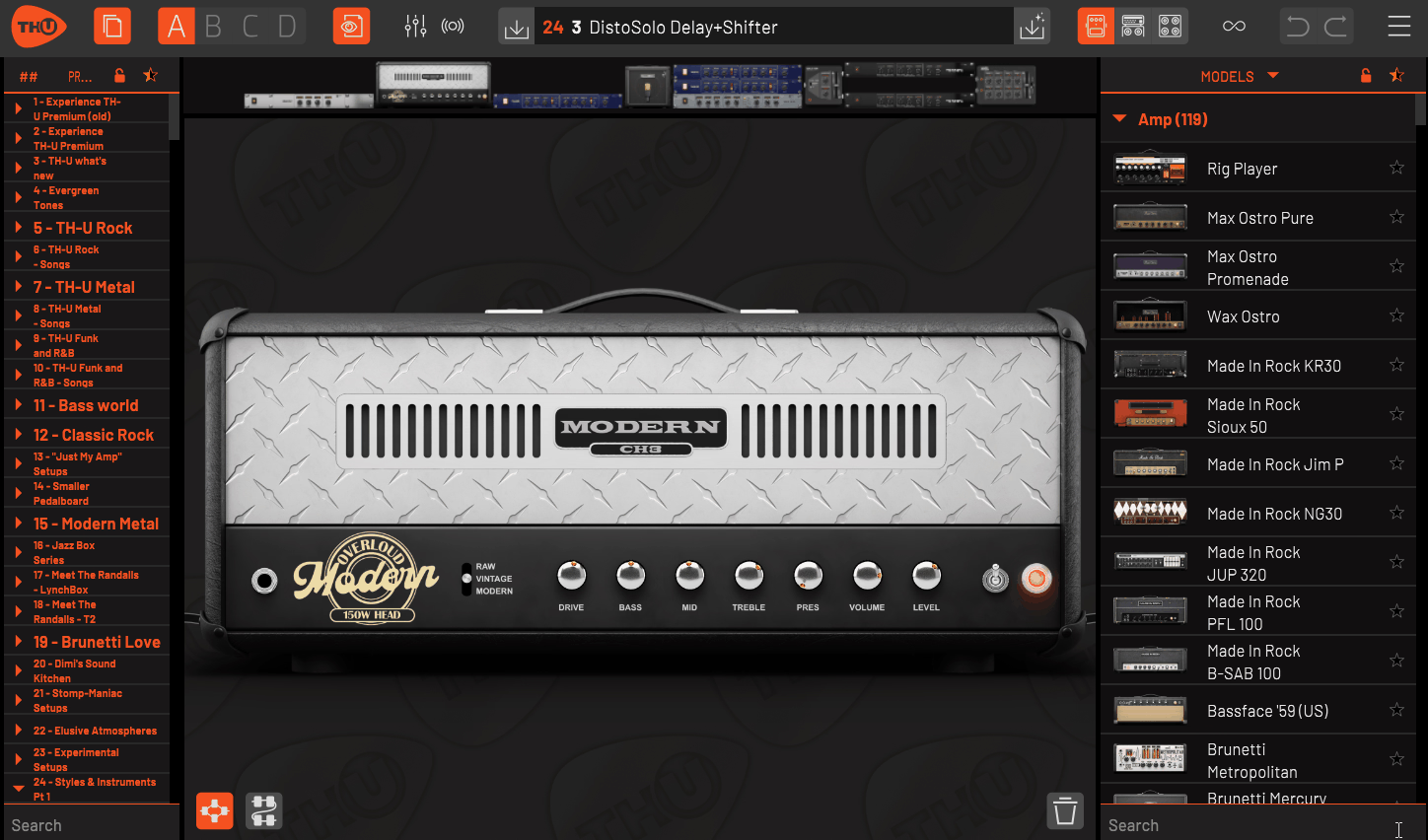
Overloud has been building amp simulation software since the early days of the category, and TH-U is their most mature release. It’s a guitar and bass amp simulation platform built around a combination of traditional circuit modeling and a Rig Player technology that uses impulse responses captured directly from real amplifier hardware rather than mathematical circuit models.
When it comes to Rig Player, it captures the full dynamic response of a real amp including the nonlinear behavior of the tubes, transformers, and speakers under different playing conditions, and plays back that captured response in real time. The practical result is basically that Rig Player presets behave more like the original hardware than a circuit model optimized for steady-state frequency response, and the difference is most audible when you dig in hard on a chord or play at the edge of the amp’s clean headroom.
TH-U delivers with a substantial component library covering the most important bases across clean, crunch, and high-gain territory:
- Over 200 amplifier models combining traditional circuit models and Rig Player captures from real hardware
- Over 100 cabinet models with adjustable microphone placement, distance, and dual mic blending
- 170+ effects covering overdrive, distortion, modulation, delay, reverb, and more
- Third-party IR loader accepting WAV format impulse responses for cabinet replacement
- Standalone mode for live and practice use without a DAW
- MIDI control with full parameter mapping for live performance and real-time expression control
- Extended library of Rig Player captures from boutique and vintage amps available through the Overloud store
The Rig Player
The Rig Player captures are where TH-U separates itself most clearly from competing platforms, and spending time with them on real playing material is what convinced me that the technology delivers on its promise.
Loading a Rig Player preset of a vintage Fender Deluxe Reverb capture and playing single-note leads at different dynamics produces a response that tracks the playing intensity in a way that feels physically connected to the hardware behavior, not just sonically similar to it.
I find the clean and edge-of-breakup Rig Player captures the most convincing application of the technology. The way the amp transitions from clean to slightly saturated as you play harder, with the specific compression and harmonic content that characterizes each captured amp, is harder to replicate through circuit modeling alone and consistently audible on close listening. On high-gain captures, the advantage over circuit modeling is less dramatic because the high gain stage compresses the dynamic range enough that the subtle nonlinear behavior of the capture is less distinguishable, but the overall feel and harmonic character still tends to be more convincing than equivalent circuit-modeled alternatives.
The traditional circuit models cover the models where Rig Player captures aren’t available, and the quality is competitive with most dedicated amp simulation platforms.
They’re not the reason to choose TH-U over alternatives, but they’re good enough that you won’t feel like you’re compromising when the specific amp you need isn’t available as a Rig Player capture.
Effects and signal chain
The 170+ effects cover the standard categories competently, with the modulation and reverb effects standing out as consistently well-implemented. The spring reverb models specifically are among the best I’ve used in an amp simulation platform, with a convincing mechanical character that suits clean and crunch guitar tones where the reverb is part of the amp sound and not a separate processing stage.
The overdrive and distortion pedals are better than average for an amp simulation platform but still fall short of dedicated pedal emulation plugins for applications where the pedal character is central to the tone. I use the internal pedals for quick session work where a broadly convincing result is sufficient, and reach for dedicated pedal plugins when the specific character of a particular pedal matters to the final sound.
The signal chain supports flexible routing with parallel paths, effects loops, and the ability to place components anywhere in the chain. I find the routing flexibility most useful for wet-dry-wet setups and parallel amp blending, where running two amp paths simultaneously produces a combined tone with more complexity than either amp alone.
Cabinet and microphone
The dual microphone system lets you blend 2 microphones on the same cabinet with independent placement, angle, and distance, and the IR loader extends the cabinet options beyond the factory library. I load commercial IRs from specialized cabinet IR developers on sessions where the factory cabinets don’t have the specific tonal character I need, and the quality gap between the best commercial IRs and the factory cabinets is large enough that the IR loader is practically essential for serious recording use.
The built-in cabinet EQ per channel lets you shape the frequency response of the cabinet output without an external EQ, and I use it most for trimming the low-end resonance of closed-back cabinet models that can accumulate too much low-mid energy at higher gain settings. Having that control within the cabinet section rather than after it in the effects chain produces a more integrated result than post-cabinet EQ correction.
Pros and cons
Pros:
- Rig Player technology
The real hardware captures produce dynamic response behavior that circuit modeling doesn’t replicate as naturally, and on clean and edge-of-breakup material specifically the difference between a Rig Player preset and a circuit-modeled equivalent is consistently audible. This is the primary reason to choose TH-U over platforms without equivalent capture technology.
- Effects quality
The modulation and reverb effects are well above average for an amp simulation platform, and the spring reverb models specifically are convincing enough that I use them as primary reverb on guitar tracks and not just as convenience processing.
- Routing flexibility
Parallel amp paths, effects loops, and flexible component placement cover the most common complex signal chain requirements without external routing workarounds, and I find the parallel amp blending capability specifically produces results that justify the routing depth.
Cons:
- Rig Player library coverage
The most convincing aspect of TH-U is the Rig Player technology, but the capture library doesn’t cover every amp you might need, and the traditional circuit models that fill those gaps are good but not exceptional. If the specific amp character you need isn’t available as a Rig Player capture, you’re using a platform whose primary advantage doesn’t apply to your use case.
- High-gain capture advantage is subtle
The Rig Player technology’s most audible benefit is on clean and edge-of-breakup material. At high-gain settings the advantage over circuit modeling is less consistent, which means high-gain players get less direct benefit from the core technology that distinguishes TH-U from competing platforms.
- Expanding the Rig Player library costs extra
Additional Rig Player captures beyond the factory library are available through the Overloud store at additional cost, and building a comprehensive capture library of boutique and vintage amps adds up.
The base library covers the most common amp types, but if you regularly need captures of less common hardware, that additional cost is worth factoring into the total price of the platform.
Verdict
I would say the Rig Player technology is the reason to buy Overloud TH-U, and everything else in the platform, the circuit models, the effects, the cabinet system, is competitive but not uniquely compelling on its own.
If the dynamic response behavior of real captured hardware on clean and edge-of-breakup tones is something you can hear and care about in your playing, the price makes sense. If it isn’t, you’re paying a premium for a technical advantage that doesn’t apply to your most common use cases.
High-gain players get the least direct benefit from what makes TH-U distinctive, and for that specific application dedicated platforms from Neural DSP or Line 6 Helix Native produce more uniformly convincing results across the component library. The Rig Player captures at high gain are still good, but the gap between them and the competition narrows considerably compared to what the technology achieves on cleaner material.
Where TH-U genuinely earns its price is on sessions where clean tone realism, dynamic response to playing intensity, and edge-of-breakup behavior are the priority. Blues, soul, country, indie, and any production context where the amp needs to respond to how hard you play and not just what settings you’ve dialed in.

Hey, I’m Vil, I started this site to help you find the best audio plugins covering various categories including synths, pianos, strings, and effect tools of all sorts as well. I pick these plugins based on various criteria so it best matches the actual topic.