When you purchase through the links on my site, you support the site at no extra cost to you. Here is how it works.
Eventide has a long history with modulation effects, and TriceraChorus draws specifically from bucket brigade delay (BBD) chorus circuits that defined the sound of the late 1970s and 1980s.
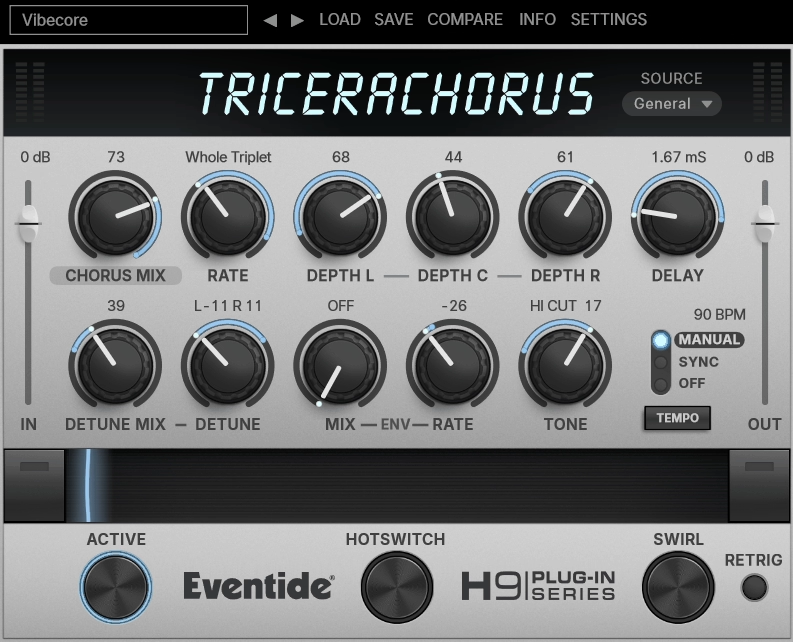
The name references the three distinct chorus engines running simultaneously inside the plugin, each modeled after a different era of BBD hardware, and honestly, that combination is what gives it a character that goes beyond a single-engine chorus.
It isn’t trying to be a flexible, modern chorus with deep voice control. Instead, it’s trying to sound like specific hardware, and the question worth answering is how convincingly it does that.
Three BBD engines, one plugin
The three chorus engines inside Evemtode TriceraChorus are modeled after distinct generations of bucket brigade delay hardware, and each one has a different sonic character based on the circuit it’s designed to represent.
The first engine produces the bright, glassy character associated with earlier BBD circuits, where limited bandwidth contributes to a particular shimmer. I find this one most useful on guitars and synths where that vintage brightness adds to the source rather than working against it.
Next, the second engine sits in warmer, darker territory associated with mid-period chorus units from the early 1980s. I’d say this one works particularly well on bass and low-mid-heavy sources where the additional warmth suits the instrument.
Lastly, the third engine covers a later BBD character that is cleaner than the first two but still carries analog warmth and slight instability. I would use this one when you want to achieve vintage character without as much obvious coloration.
Here’s what running all three engines simultaneously gives you:
- Layered BBD character from three circuit generations, producing a more complex chorus than a single-engine design.
- Independent modulation interaction, where the three LFOs can move at different rates and create less predictable movement.
- Independent rate and depth per engine, so you can build different modulation relationships rather than relying on one shared LFO.
- Analog-style bandwidth, saturation, and noise behavior, which contribute to the vintage character of the wet signal.
The analog character up close
What I love about it is that the BBD character goes beyond pitch modulation. The plugin also shapes the frequency response and saturation of the wet signal, which affects how the chorus actually sits in a mix.
The bandwidth limiting of each engine is noticeable when you compare it with a clean digital chorus. I noticed that the effected signal is softer in the highs, so the chorus doesn’t compete with the dry signal as aggressively.
The noise floor also contributes to the character. I’ve used plugin at higher drive settings on guitars because the extra noise and saturation can give the effect a more worn, analog quality when that’s what the track needs.
- Drive and saturation behavior
Each engine has its own drive control, and I feel like the saturation character changes from one engine to another. The first has a brighter, more aggressive response, while the second feels warmer and the third is more restrained.
I’d recommend keeping the drive at moderate settings unless you specifically want audible saturation. On the second engine, I particularly like a small amount of drive because it adds body and thickness without turning the chorus into an obvious distortion effect.
- Modulation and rate interaction
The three independent LFOs are one of the main reasons it doesn’t behave like a conventional synchronized multi-voice chorus. In my opinion, slightly different modulation rates create movement that feels less repetitive and more organic.
I noticed this most clearly on sustained pads, where a synchronized chorus can become predictable after a while. Plugin keeps shifting subtly because the engines aren’t all following exactly the same movement.
Where it sounds right
- Guitars, both electric and clean
From my perspective, this is where it is most convincing. The BBD character suits guitar especially well, because the filtering and saturation sit naturally with the instrument’s harmonic content.
On clean electric guitar, the first engine with a moderate rate and light drive gives you a bright, shimmering chorus that fits the classic sound of the era. I mean, the appeal isn’t simply that it sounds “vintage”; the coloration feels like part of the effect rather than an EQ trick applied afterward.
- Synthesizers and vintage keys
The second and third engines work particularly well on Juno-style pads, electric piano, and other vintage-leaning sounds. I like how the chorus can feel almost as though it belongs to the instrument instead of sounding like a separate plugin placed afterward.
I’ve also found it useful on modern synthesizers when you want character rather than just width. The combination of modulation, saturation, and bandwidth shaping changes the overall tone, not simply the stereo image.
- Bass
On bass, you can use the second engine at conservative settings, keeping the depth low and the rate slow. I’d say the warmer character works well here because you can add movement and body without pushing the fundamental around too aggressively.
You should still be careful with chorus on low-frequency material. Too much modulation can weaken the center and make the bass less focused, so for me, subtlety is usually the better starting point.
Pros
- Three independent BBD engines
Honestly, running three distinct circuit emulations gives TriceraChorus a depth that you don’t get from a basic single-engine chorus. The interaction between the different modulation rates is a big part of that character, especially on sustained sounds.
- Authentic BBD saturation and noise
What stands out to me is how the frequency response and saturation help the effect sit in the mix. The softer highs keep the wet signal from becoming overly bright, while the subtle analog character gives the chorus more personality.
- Independent rate and depth per engine
I love how setting the three engines at different rates creates less repetitive modulation. You can make the effect feel more alive without simply increasing the depth.
Cons
- Not a clean or modern chorus
The BBD character is always part of the sound. TriceraChorus isn’t the right choice if you want transparent chorus that simply adds width without tonal coloration.
- Less practical for per-voice customization
On the other hand, the fixed three-engine architecture means you don’t get the per-voice pitch, delay, pan, and level control that a more flexible chorus such as Choric provides. If precise voice arrangement is your priority, another workflow may suit you better.
How good is it?
Genuinely good, specifically at what it’s designed to do. The three-engine BBD architecture, combined with independent modulation and analog-style saturation, gives this plugin a vintage chorus character that I find particularly convincing on guitars, synthesizers, keys, and bass.
At the end of the day, it isn’t the right tool for every chorus application but if you need vintage BBD character and want the effect to feel like part of the hardware-inspired sound rather than a clean digital chorus, I’d say it delivers.
TriceraChorus is available for around $99 and runs as a VST3, AU, and AAX plugin on both Mac and Windows with native Apple Silicon support. I’d suggest starting with the second engine on a guitar or synth pad and experimenting with the drive control, because that gives you a quick sense of how much of the plugin’s character comes from the BBD-style processing rather than the chorus modulation alone.

Hey, I’m Vil, I started this site to help you find the best audio plugins covering various categories including synths, pianos, strings, and effect tools of all sorts as well. I pick these plugins based on various criteria so it best matches the actual topic.