When you purchase through the links on my site, you support the site at no extra cost to you. Here is how it works.
Surge XT started as a commercial synthesizer, became open-source in 2018, and has since developed into one of the most technically comprehensive free synthesizers available.
Being completely free, actively maintained, and genuinely deep in its synthesis capabilities makes it an unusual proposition in a market where depth usually costs money.
I’ve Surge XT it across electronic music, sound design, and cinematic production, and it competes seriously with paid synthesizers costing significantly more than what you’d expect from a free instrument.
The oscillator architecture
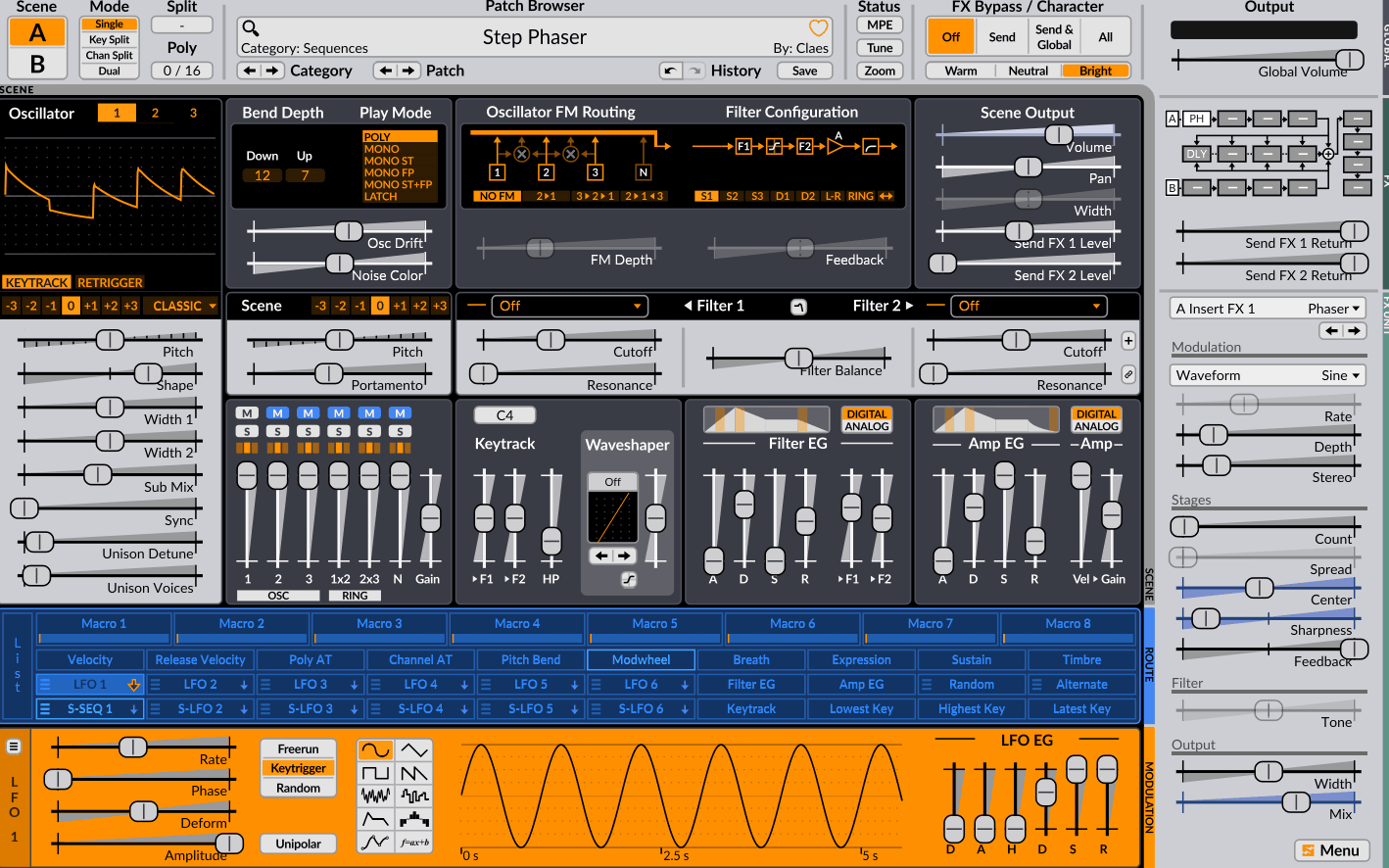
It’s built around 3 oscillator slots per voice, each supporting 12 oscillator types that cover meaningfully different synthesis approaches.
The Classic oscillator covers analog-modeled waveforms with unison up to 16 voices and sub-oscillator output. The Wavetable oscillator ships with over 500 factory wavetables with real-time morphing and audio import.
The String and Twist oscillators cover physical modeling and FM-adjacent territory, and the Alias oscillator deliberately introduces aliasing as a creative tool.
I find the combination of oscillator types within a single patch the most practically powerful aspect. Running a Wavetable oscillator for modern spectral movement alongside a Classic oscillator for analog warmth and a String oscillator for physical plausibility produces hybrid sounds that single-engine synthesizers can’t replicate, and once you start combining oscillator types deliberately you’ll find it hard to go back.
The 3×3 FM matrix routing lets any oscillator modulate any other at audio rate with adjustable depth per connection, producing FM synthesis results with the timbral variety of wavetable scanning and not the fixed operator relationships of a conventional FM synthesizer.
Here’s what the oscillator architecture gives you:
- 12 oscillator types per slot covering analog-modeled, wavetable, window, FM, string, alias, and experimental options with fundamentally different synthesis characters
- Over 500 factory wavetables with audio import and real-time morphing between frames
- 3×3 FM matrix allowing any oscillator to modulate any other at audio rate
- Unison up to 16 voices with independent detune, spread, and pan per unison voice
Filter section
Surge XT ships with over 60 filter types across multiple families, and the variety is genuinely meaningful. The Vintage Ladder models classic ladder nonlinear behavior with resonance that builds into self-oscillation. The Comb filter produces physical modeling-adjacent tones with delay-based resonance. The Vocal formant filters produce vowel-like timbral movement without an external vocoder.
The dual filter architecture runs 2 filters simultaneously with serial, parallel, and morph routing. The morph routing produces a continuously variable blend between 2 filter characters that neither fixed routing option achieves, and I use it most on filter sweeps where I want the character to evolve as the cutoff moves. If you spend time with it, you’ll find it produces tonal transitions that single-filter alternatives can’t replicate.
Modulation system
You get 3 LFOs per voice, 3 scene-level LFOs, 12 envelope generators, 4 macro controls, and formula-based modulation using a built-in scripting language that lets you define custom modulation shapes mathematically.
The formula modulator is the most technically distinctive feature in the system. Writing a simple mathematical expression produces modulation behaviors that no LFO waveform library naturally generates, and for producers with basic programming knowledge it opens up modulation territory that no competing synthesizer approaches as directly. I use it most for physically motivated modulation shapes that mimic natural acoustic behavior, and once you understand what it’s capable of you’ll use it on almost every complex patch you build.
The step sequencer covers up to 16 steps with per-step value, gate, and detuning, modulating any parameter in the synthesis engine. Running a 16-step sequence on the filter cutoff with a simultaneous 8-step sequence on the wavetable position produces rhythmic timbral variation that feels composed, and having both running at different lengths creates evolving polyrhythmic relationships you won’t easily replicate elsewhere.
- Formula modulator
Defines custom modulation shapes mathematically, producing behaviors that no LFO waveform library generates. If you have any programming background, this opens up modulation territory you won’t find in any other free synthesizer.
- 3 LFOs per voice plus 3 scene LFOs
Voice-level LFOs track individual note behavior independently while scene LFOs affect all voices identically. I find this most useful on polyphonic pads where you want each voice behaving slightly differently from the others.
- 12 envelope generators
Independent envelope control over almost any parameter simultaneously. I use independent envelopes on filter cutoff, wavetable position, and oscillator FM depth within the same patch, producing dynamic timbral evolution that a single shared envelope can’t generate.
Effects and routing
2 independent effects chains of 8 slots each covering over 30 effect types including reverb, delay, chorus, phaser, distortion, EQ, compressor, vocoder, and rotary speaker. The quality of several effects is competitive with dedicated plugins you’d otherwise pay for separately.
The Airwindows integration brings exceptional open-source effects into the chain, and the Conditioner combines EQ, stereo width, and soft-clip limiting in a single processor I use as a final stage before the DAW chain.
Voice-level effects process each note independently while scene-level effects process the summed output of all voices simultaneously. Running chorus at voice level on a pad produces individual pitch variation per note. The same chorus at scene level applies to the combined chord, and the difference is immediately audible when you switch between the two.
Patch library and workflow
The factory library covers over 2000 presets contributed largely by professional sound designers, and I find it more practically useful as a starting point than most commercial synthesizer factory content at any price range.
The patch browser supports tagging, favoriting, and text search, and the A/B patch comparison lets you switch between 2 patch states without losing your current settings, which I use consistently during sound design to evaluate variations without committing to either.
Pros and cons
Pros:
- 12 oscillator types with FM matrix
The combination of 12 fundamentally different oscillator types per slot with 3×3 FM matrix routing covers synthesis territory that most paid synthesizers don’t approach. Combining oscillator types within a single patch produces hybrid sounds that single-engine synthesizers can’t replicate, and I find this the single most practically valuable technical advantage over commercial alternatives.
- Formula modulator
The built-in scripting language for custom modulation shapes is genuinely unique in the synthesizer market. For producers willing to invest time in understanding it, the formula modulator opens up modulation territory that no competing synthesizer you can buy approaches as directly.
- Completely free with active development
Entirely free, open-source, and actively maintained means the platform improves consistently without additional purchases. If you’re budget-conscious, this alone makes it worth adding to your setup immediately.
Cons:
- Steep learning curve
12 oscillator types, 60+ filter types, formula modulator, and dual effects chains involve enough decision points that the learning curve is genuinely steep. You should expect to invest several sessions before the interface starts feeling natural.
- Interface density
More information visible simultaneously than most synthesizers, and on smaller displays the parameter density makes precise adjustments harder. I find it manageable on large displays but challenging on laptop screens where you’ll need careful mouse control.
- Preset browser organization
Finding sounds by tonal character requires more manual auditioning than a visual browser would allow. If you primarily work from presets, you’ll find discovery slower than synthesizers with more advanced browser implementations.
My opinion
I’ve recommended Surge XT to producers at every level, from bedroom producers looking for their first serious synthesizer to professional sound designers who already own every major commercial option, and the response is consistently the same: surprise at how much is here once you get past the interface density.
What I find most compelling isn’t any single feature but the combination of the formula modulator, the 12 oscillator types, and the FM matrix operating together in a synthesis environment that costs nothing. I’ve built patches in Surge XT that I’ve gone back to on professional sessions and reached for over paid alternatives.
The learning curve is real and I won’t minimize it. The first few sessions feel like you’re fighting the interface. But that investment pays off faster than you’d expect, and the point where it starts feeling intuitive tends to arrive around the same time you realize you’ve built something that no other free synthesizer could have produced.
If you’re evaluating it against paid alternatives, spend time specifically with the formula modulator and the oscillator combinations before forming a judgment, because those are the features with no equivalent in most commercial synthesizers.
Verdict
For a free synthesizer, Surge XT isn’t just good relative to its price, it’s genuinely competitive with commercial synthesizers costing several hundred dollars. The 12 oscillator types, 3×3 FM matrix, 60+ filter types, formula modulator, and dual effects chains combine into a synthesis environment that covers more ground than most paid alternatives.
It’s less immediately accessible than more streamlined commercial synthesizers, and if fast workflow and preset-based sound selection are your priorities, the interface density and learning curve will work against you.
But if sound design depth and synthesis variety are what you’re after, I’d put Surge XT in your setup before spending money on a commercial synthesizer covering similar ground. The price makes it worth trying, and the depth makes it worth staying.

Hey, I’m Vil, I started this site to help you find the best audio plugins covering various categories including synths, pianos, strings, and effect tools of all sorts as well. I pick these plugins based on various criteria so it best matches the actual topic.