When you purchase through the links on my site, you support the site at no extra cost to you. Here is how it works.
The Neve 1073 is one of the most copied preamp and EQ designs in recording history, and that ubiquity cuts both ways. There are more 1073-style plugins than any producer needs, and the quality range across them is enormous.
Waves collaborated with Andrew Scheps, one of the most respected mixing engineers working today, to build their version, and the result is a plugin that carries a specific pedigree worth examining honestly rather than just taking at face value.
I’ve used it across rock, metal, pop, and electronic mixing sessions, and the honest assessment is that it sounds good enough to be a regular session tool, but the reasons to choose it over competing 1073 emulations are more specific than the marketing suggests.
The character
What makes the Scheps 1073 appealing comes down to a specific combination of transformer coloration, inductor-based EQ behavior, and preamp harmonic saturation that produces a warmth and density that clean digital processing doesn’t naturally generate.
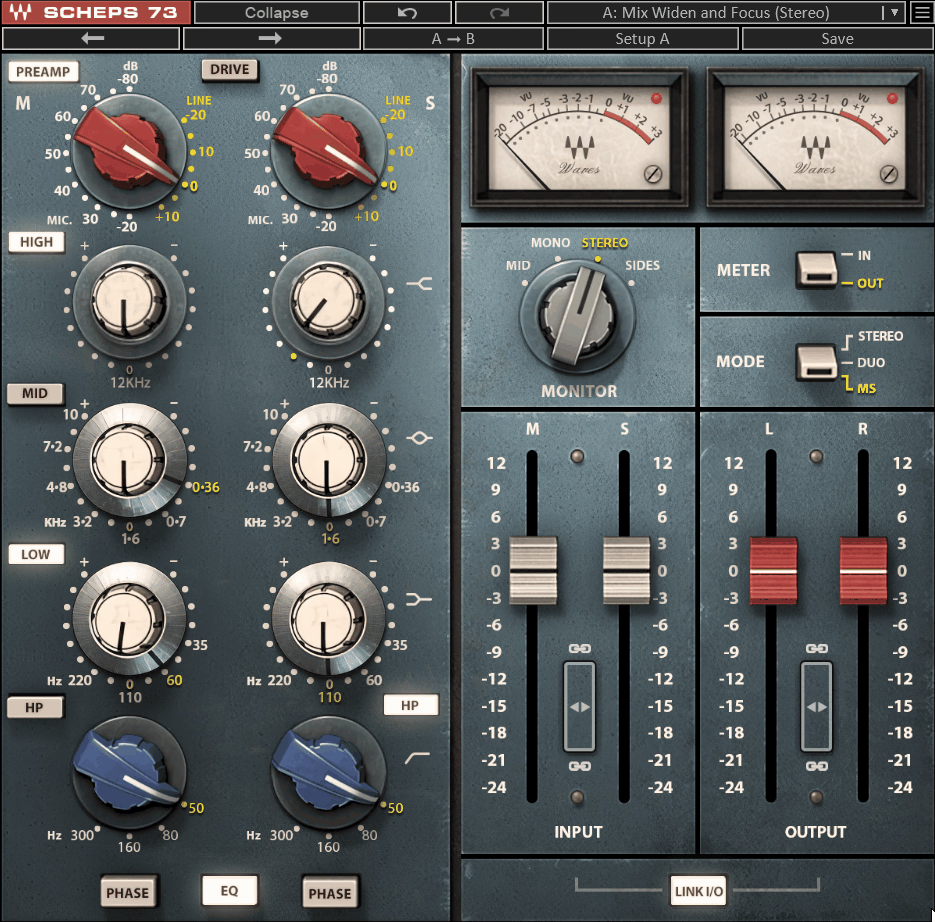
Scheps 73 models the full signal chain including the input transformer, three-band EQ with high-pass filter, and output stage, and the interaction between those elements is what produces the characteristic color that makes 1073-style processing useful on virtually any source.
Andrew Scheps specifically contributed a calibrated version of the circuit that reflects how the hardware actually behaves in a professional mixing context and not how it measures on a test bench.
Subtle differences between a well-maintained hardware unit and a poorly maintained one are significant enough to matter on close listening, and having a reference mix engineer’s calibration as the starting point is a more meaningful differentiator than it might initially seem.
How it actually sounds
What matters most about the sound:
- Low shelf
Adds warmth and weight that feels like the source got physically larger and not just louder in the low frequencies. I find it most useful on sources that need low-end body without the clinical precision of a parametric boost, and that quality comes from the inductor-based shelf behavior interacting with the harmonic content of the signal and not from the frequency response curve alone.
- Midrange
This is where I spend the most time and where the character is most audible. Each position has an asymmetric bell curve that produces a different tonal result from a symmetrical parametric at equivalent settings, and boosting the presence range on a vocal or guitar adds cut and definition without the harshness a clean digital parametric introduces at the same amount.
- High shelf
Smooth and open, suited to air and presence boosting where brightness needs to feel natural and not processed.
I’ve used it on lead vocals where a clean digital shelf reads as harsh on sibilant performances, and the inductor-based character consistently produces the same perceived brightness with a more integrated quality that sits better in the mix without additional de-essing.
- High-pass filter
Behaves differently from a standard digital high-pass at equivalent cutoff points, with a slope and resonance character specific to the original hardware.
The transition from filtered to unfiltered feels more musical than most digital alternatives, and I use it on most sources as a first step for clearing low-end content that’s muddying the mix without affecting the fundamental character of the instrument.
The harmonic saturation
Beyond the EQ curve, the transformer and output stage saturation is where Scheps 73 adds character that makes it useful as a mixing tool and not just an EQ. At moderate drive levels the saturation adds even-order harmonics that warm the midrange and add density to the low end in a way that complements the EQ adjustments rather than just adding coloration on top of them.
I use it on mix buses and individual channels specifically for this saturation quality, often with minimal EQ adjustment, because the harmonic character of the output stage alone is enough to improve how a sound integrates in the mix.
On a dense rock or metal mix where the midrange is congested, running individual channels through at moderate drive levels clears space through harmonic interaction and not just through EQ cuts, and that distinction is what makes it faster and more musical than trying to solve the same problem with a parametric EQ alone.
What matters most:
- Inductor-based EQ character
Shelves and midrange bell produce tonal adjustments with the integrated, musical quality of inductor-based hardware that digital EQ curves don’t replicate at equivalent boost values.
You’ll notice the difference most at higher boost values where clean digital processing starts to sound like processing and Scheps 73 sounds like the source material changed tonally.
- Five-position midrange
Frequency centers reflect the original hardware’s design choices for musical usefulness, and the bell behavior at each position has the asymmetric curve shape of inductor-based EQ that produces a different tonal result from a symmetrical parametric bell at the same settings.
- High-pass filter with hardware slope
The specific slope and resonance character of the original hardware produces a different low-frequency transition from standard digital high-pass filters, and I find it more musical on sources where the high-pass is doing significant work in the mix.
- Output stage harmonic saturation
Saturation from the transformer and output stage modeling adds even-order harmonics that improve mix integration independently of the EQ adjustments. I use this quality specifically on mix buses and individual channels where the harmonic character is the primary reason to reach for the plugin and not just the EQ curve.
Where it earns its place in metal and rock
Electric guitars are where I reach for Scheps 73 most consistently in rock and metal mixing. The presence midrange position controls the aggression and cut of a distorted guitar in a way that digital parametric EQs handle less musically at equivalent boost values, and the output stage saturation adds harmonic density that helps the guitar sit in a dense arrangement without competing with other midrange elements. It’s one of those EQs where a small amount of processing produces a disproportionately large improvement in how the guitar integrates with the rest of the mix.
Bass guitar benefits from the full signal chain in metal production. The low shelf adds weight and body, the low-mid position controls the accumulation of mud between the bass and kick drum, and the high-pass clears the sub-bass region in a way that lets the kick occupy that space without competition.
Combining all three together produces a bass sound that sits in the kick’s pocket more naturally than surgical parametric moves on the same material, and I find it one of the faster ways to solve the bass and kick relationship in a dense metal mix.
On drums, I keep EQ adjustments conservative and let the saturation do most of the work. Transformer coloration and harmonic saturation add the analog density that makes a drum kit feel recorded and not programmed or sampled, and on a metal drum bus that cohesion and warmth is something DAW processing alone doesn’t generate with the same naturalness.
The less you move the EQ controls and the more you let the circuit character do the work, the more useful this plugin becomes on bus material.
Vocals in a dense rock or metal arrangement benefit from the presence and air characteristics of the midrange and high shelf, which add cut and openness without the harshness that aggressive digital boosting introduces on bright or sibilant performances.
Output stage saturation adds harmonic density that makes the vocal feel present and forward without additional compression or saturation after it, and I find that combination faster to reach for than building the same result from separate processors.
Pros and cons
Pros:
- Inductor-based EQ character
Shelves and midrange bell produce tonal adjustments with the integrated, musical quality of inductor-based hardware. You’ll notice the difference most at moderate to significant boost values where clean digital processing starts to sound like processing and Scheps 73 sounds like the source changed tonally, and that distinction is consistently audible on guitars, vocals, and bus material.
- Output stage saturation
Harmonic saturation from the transformer and output stage modeling improves mix integration independently of the EQ adjustments. I use it specifically on mix buses and individual channels where the saturation character is the primary reason to reach for it and not just the EQ curve.
- Andrew Scheps calibration
Having a professional mix engineer’s calibration as the starting point produces hardware behavior that reflects real-world studio use and not just measurement accuracy, and that difference is audible on close listening compared to 1073 emulations calibrated purely against hardware measurements.
Cons:
- Limited EQ flexibility
Fixed frequency positions and the absence of a sweepable midrange make Scheps 73 less flexible than a fully parametric EQ for surgical frequency management. If you need precise frequency targeting on a problem frequency that sits between the available positions, you’ll need a separate EQ alongside it, and it works best as a color EQ paired with a parametric tool and not as a replacement for one.
- Price versus competing 1073 emulations
UAD’s 1073 emulation, Neve’s own software versions, and several independent developers produce competing 1073-style plugins across a wide price range, and some are competitive with Scheps 73 at lower cost. The Andrew Scheps calibration and the Waves workflow integration justify the price if those specific qualities matter to you, but the premium over budget alternatives is hard to justify on EQ quality alone.
- Less distinctive at conservative settings
The character that makes Scheps 73 useful is most audible at moderate to significant processing levels. At very conservative settings the difference from a clean digital EQ is subtle enough that you might not hear a meaningful improvement over what you already have, and if you tend to work with minimal EQ moves the investment is harder to justify.
Verdict
Waves Scheps 73 sounds like a well-maintained Neve 1073 in the hands of someone who knows how to use one, which is both the clearest way to describe it and the most honest assessment of what you’re actually buying. The inductor-based EQ character, output stage saturation, and Andrew Scheps calibration combine into a plugin that improves the integration and density of whatever you run through it, and I find it one of the more consistently useful color EQs in my mixing chain across rock, metal, and dense mix applications.
It’s not the most flexible EQ in a mix session, and it’s not the cheapest 1073 emulation available. Instead, it is a specific tool that does something specific extremely well, and if the character of a well-calibrated Neve 1073 is something you reach for regularly in your mixing work, Scheps 73 delivers that character consistently enough to justify its place in a professional mixing setup.

Hey, I’m Vil, I started this site to help you find the best audio plugins covering various categories including synths, pianos, strings, and effect tools of all sorts as well. I pick these plugins based on various criteria so it best matches the actual topic.