When you purchase through the links on my site, you support the site at no extra cost to you. Here is how it works.
Let’s talk about how to pick the best convolution reverb plugin for your setup, since the right choice really depends on whether you’re after strict realism or something more flexible.
Convolution reverb captures the acoustic fingerprint of a real space, called an impulse response, and applies it to your audio, which is exactly why they still sound more believable than most algorithmic reverbs, even decades after the technology first landed in plugin form. I’ll keep this short and practical so you can find the one that actually fits what you’re working on.
A few names worth knowing up front: Audio Ease Altiverb 8, AudioThing Fog Convolver 2, Waves IR1 Convolution Reverb, LiquidSonics Reverberate 3, and Kilohearts Convolver, plus a few solid free options near the end. Full rundown of each one is below.
1. AudioThing Fog Convolver 2
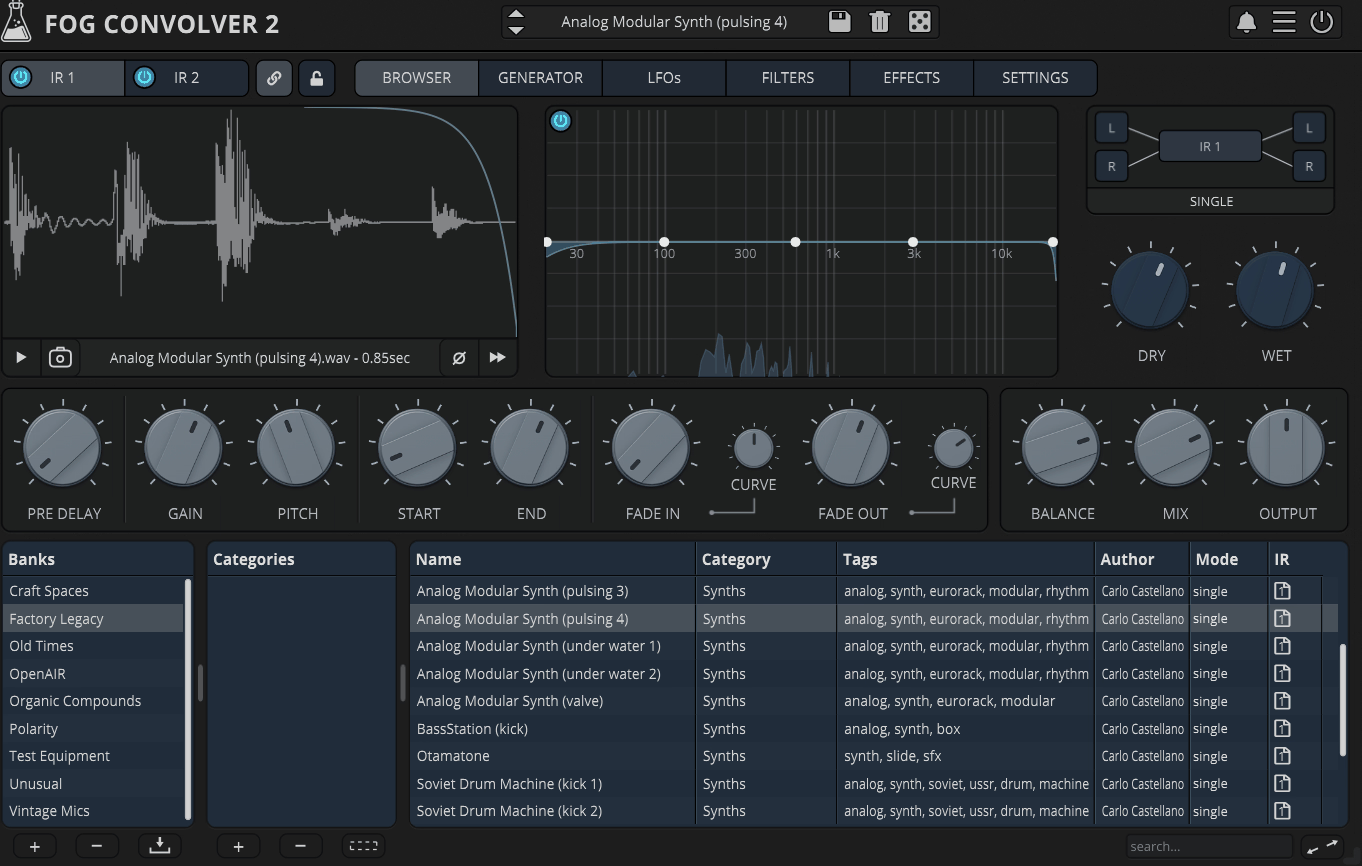
Version one of Fog Convolver was a fairly simple convolution processor, and I think that’s exactly why version two feels like such a jump. It was rewritten completely from scratch for this release, with the whole engine redesigned around a true stereo signal path instead of the older mono-focused approach.
On top of that core rebuild, the team added modulation, built-in effects, a space simulator, and an impulse generator, none of which existed in the original.
The plugin that resulted from all of that is AudioThing Fog Convolver 2, and it can load two separate impulse responses at once with independent or linked controls for each.
- Five Routing Modes
You can arrange your two loaded impulses in single, serial, parallel, parallel mix, or true stereo routing, and I’d recommend experimenting with parallel mode specifically if you want two very different spaces blended into one texture.
- Dual LFO Modulation Per Impulse
Each impulse response gets two LFOs with 10 waveforms and 18 possible destinations, which I think opens up genuinely evolving, non-static reverb tails that a plain convolution engine just can’t produce.
- Over 700 Factory Impulse Responses
Nine factory banks cover more than 700 impulse responses, including an “Old Times” bank pulled from public domain 78 RPM records, NASA recordings, old radio broadcasts, and wax cylinders. I think that last bank alone is worth it if you’re into lo-fi textures.
- Built-In Space Simulator
You can define a virtual room’s dimensions, materials, and source and listener placement across all six walls, essentially building a custom acoustic space instead of relying only on recorded impulses. I found this genuinely fun to mess around with, honestly more than I expected going in.
- Snapshot Automation System
A Snapshot system lets you save the plugin’s full state to a slot and automate transitions between them, which I like a lot for building reverb that actually changes shape over the course of a track instead of sitting static.
2. Kilohearts Convolver
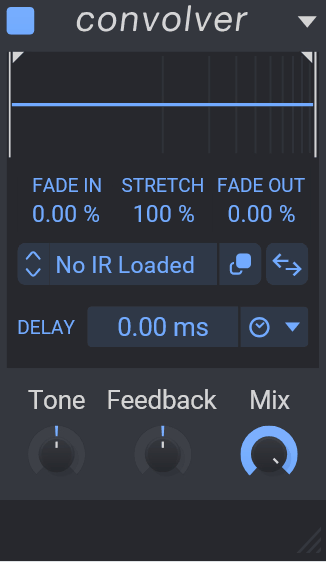
Convolving one sound with another is, at its core, a way of multiplying their frequency content together, and reverb just happens to be the most common use for that math. You get exactly that flexibility from Kilohearts Convolver, which treats any impulse response, whether it’s a room, a guitar cabinet, or a weird filter, as fair game.
- Over 300 Factory Impulse Responses
The plugin ships with more than 300 factory IRs, and I like that they’re not limited to reverb spaces; you get guitar cabinets, delays, and filter-style impulses mixed right in with the room recordings.
- Import Any Audio Sample as an IR
In addition, you can load literally any audio file as an impulse response, which means you’re not stuck with what’s included. I’ve used this to convolve drums with weird found sounds just to see what happens, and to be honest some of the results were unusable, but a few were genuinely great.
- Stretch and Reverse Controls
The Stretch control adjusts both length and pitch of the loaded impulse, and Reverse flips it entirely before processing, both of which require a quick precomputation step before you hear the result. I’d say it’s a small tradeoff for the flexibility you get.
- Feedback Into the Convolution Engine
A Feedback control routes the processed output back into the engine itself, which I think is the feature that turns this from a simple reverb into something you can genuinely design with.
3. Audio Ease Altiverb 8
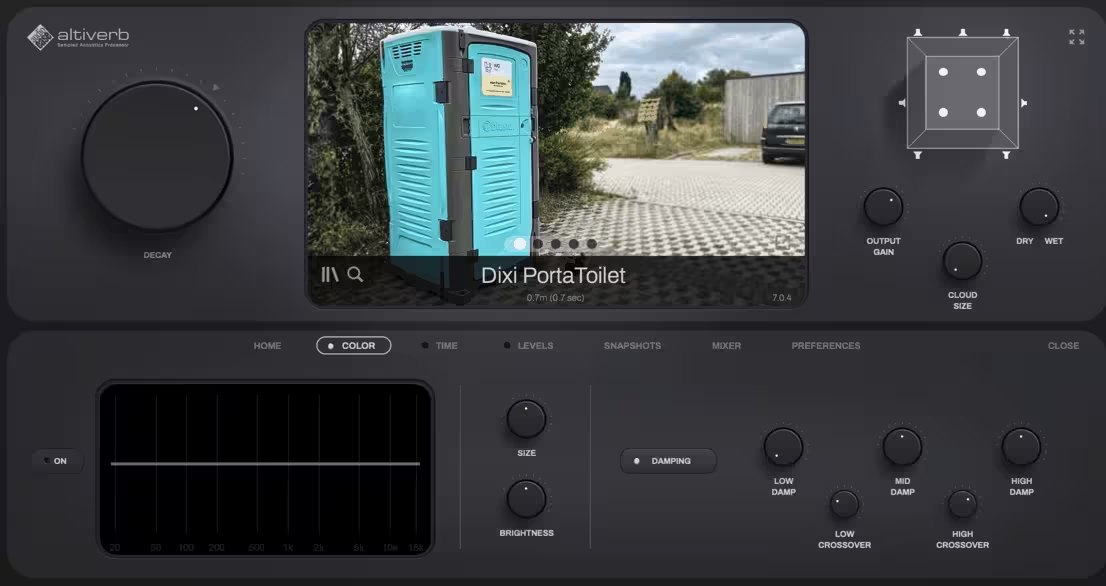
The plugin that basically defined the category, and one that’s still adding new impulse responses for free every month for existing users, is Audio Ease Altiverb 8.
It was recorded pretty much everywhere: the Sydney Opera House, London’s Wembley Stadium, and a Scottish underground oil tank the size of a cathedral, among hundreds of other spaces.
I like that stereo and mono sources get a Positioner tab for moving the source around the virtual space, while multichannel setups get a Cloud Size control instead, which automatically follows your input’s pan position. At the very least it means you’re not manually repositioning reverb every time a source moves.
- Dolby Atmos Support
The XL edition handles up to 9.1.6 channels for genuinely immersive convolution reverb, which I think is a big deal if you’re doing any Atmos work, since most convolution plugins still haven’t caught up here.
- Classic Hardware Emulations
Beyond real rooms, you also get EMT plates, spring reverbs, and classic digital units like the 480, 224, and RMX 16, plus the Frank Sinatra and Beach Boys echo chambers. I found these genuinely close to the real hardware, close enough that I honestly can’t tell them apart most of the time.
- Capture Your Own Impulse Responses
You can sweep any real space yourself and import the results as usable impulse responses, which I think is a nice option if you’ve got access to a room with character you actually want to keep using.
- High-Resolution Sample Rates
The XL edition supports up to 384 kHz, and the Regular edition covers up to 96 kHz, which honestly matters more for post-production and high-end mastering than it does for a quick vocal reverb.
4. SIR3 by SirAudioTools
This one’s built directly on feedback from users of the previous version, which I think shows in how considered the feature set feels. SIR3‘s core strength is its 33 HDIR models, recorded by Pinguin Ingenieurbüro in Hamburg and known specifically for their high dynamic range and natural fidelity.
- Zero-Latency, Low-CPU Processing
Despite everything going on under the hood, I found CPU usage stayed genuinely low in my own testing, and the zero-latency operation means you can use it on a live input without timing issues.
- Flexible Modulation Section
A multi-stage delay with random pitch and amplitude modulation sits in the feedback path, letting you transform the head or tail of an impulse in the time domain. I think this is what makes SIR3’s reverbs feel less static than a typical convolution plugin.
- Dynamics Processing
Also, built-in gating and ducking let you create effects like gated reverberation or duck the wet signal against the dry one, entirely inside the plugin. I like not needing a separate compressor plugin just to get that behavior.
- Six-Band EQ and Envelope Control
A 6-band EQ sits alongside envelope processing for volume, low-pass, high-pass, width, and pan, each of which can shape the impulse over time instead of applying a single static setting.
- True Stereo IR Support
You can load true stereo impulse responses directly, which I’d recommend over standard stereo files whenever they’re available, since the crosstalk between channels genuinely sounds more natural.
5. Inspired Acoustics INSPIRATA
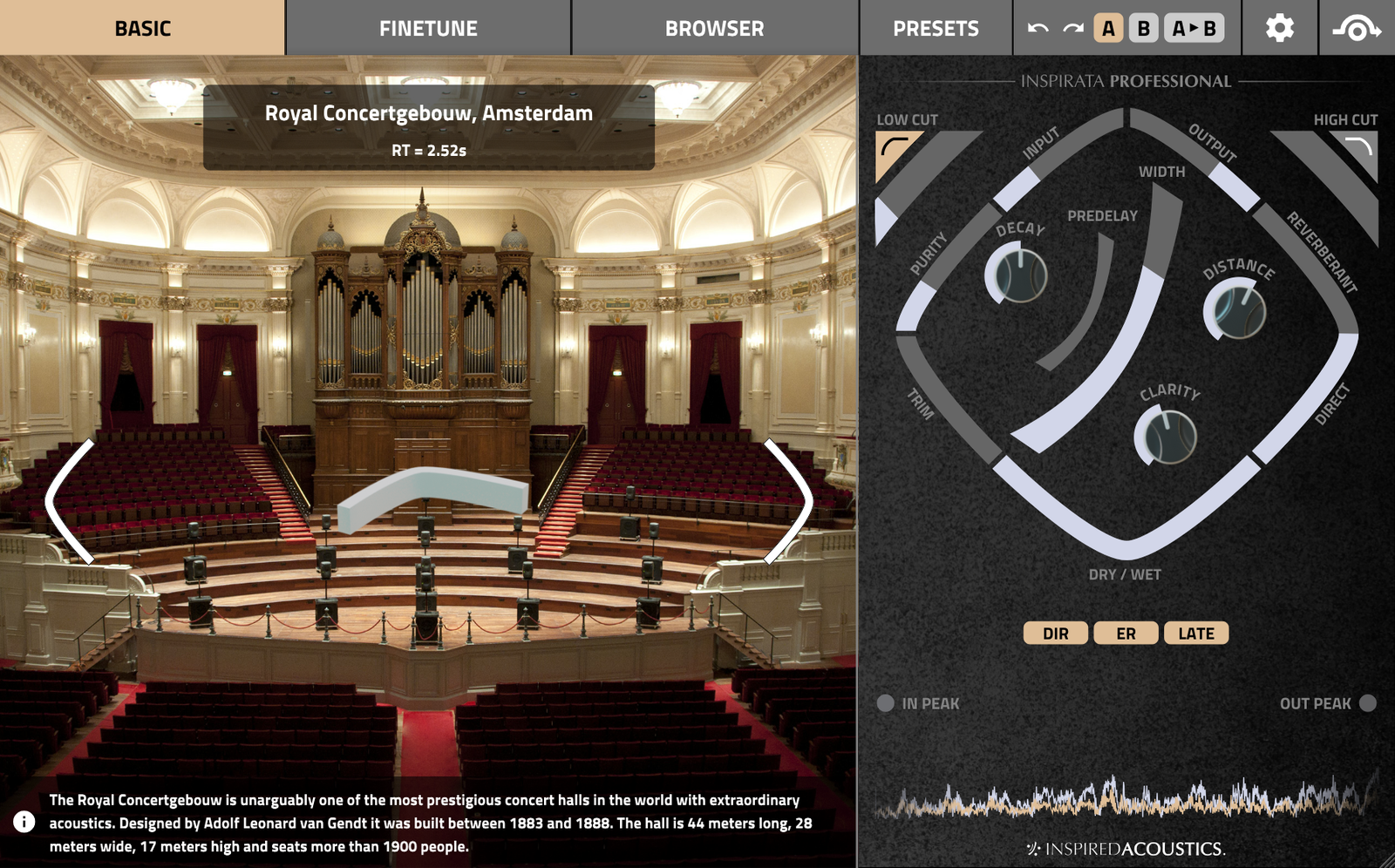
Traditional convolution reverbs can only really reproduce a single fixed source and listener position captured in one impulse response.
That’s a real limitation once you actually think about it, since real rooms don’t sound the same from every seat, and a mix with multiple instruments needs more than one snapshot to feel believable.
Because it samples each space from thousands of different source and listener combinations instead of just one, Inspired Acoustics INSPIRATA lets you move sound sources and the listener freely within a real, sampled acoustic space in real time.
- Time-Variant Computational Reverb
Inspired Acoustics calls this a “computational reverb” rather than pure convolution or algorithmic processing, and I think that distinction actually matters, since the space itself reacts differently depending on where you place things inside it.
- Real Acoustic Parameters
Instead of generic decay and size knobs, you get controls based on actual acoustic science: Sound Clarity (C80), Apparent Source Width (ASW), and Listener Envelopment (LEV). I’ll admit these took some getting used to, but they genuinely map to how a room actually feels once you learn them.
- Over 500,000 Impulse Responses
The library spans 50 sampled spaces built from more than 500,000 individual impulse responses, ranging from cathedrals and concert halls to bedrooms, offices, and near-empty airports.
- Free Source and Listener Movement
That said, you can position multiple sound sources anywhere in a space and move the listener around too, and every bit of that movement can be automated smoothly without clicks or artifacts, even when you switch the entire room model mid-automation.
- Up to 22.2 Surround and Dolby Atmos
The Immersive Edition supports surround configurations up to 22.2, including Dolby Atmos, which I think makes this one of the very few convolution tools genuinely built for immersive audio from the ground up.
- Sample Rates Up to 384 kHz
INSPIRATA supports sample rates as high as 384 kHz, which is honestly overkill for most music production, but it’s there if you’re doing high-end post work that demands it.
6. Waves IR1 Convolution Reverb
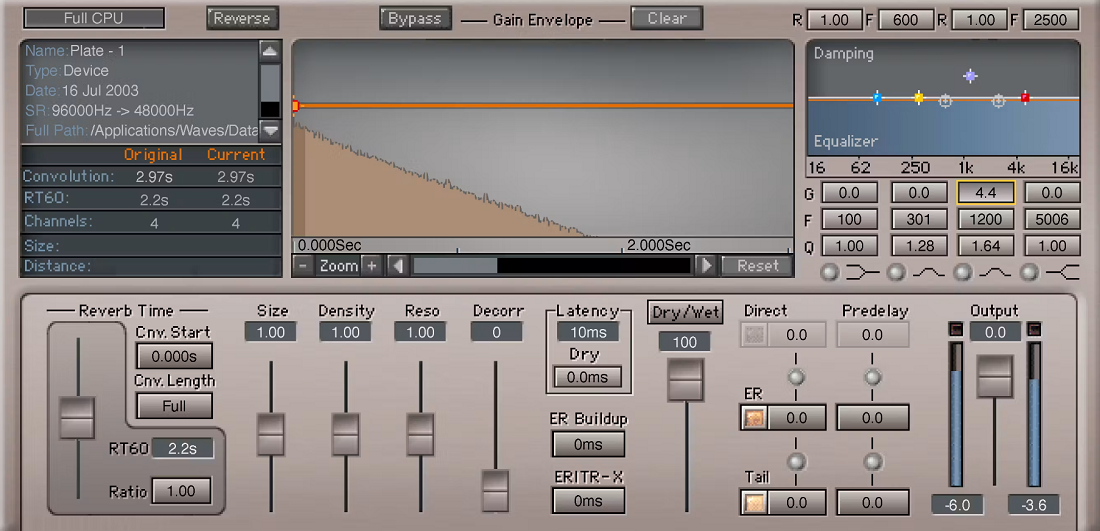
Waves IR1 puts the sampled sound of genuinely famous rooms in your hands: Wembley Arena, the Grand Ole Opry, Sydney Opera House, CBGB’s, Birdland.
I think what actually sets it apart, though, is that you can edit classic reverb parameters like RT60, size, and density in a way that changes the real convolution itself, not just a filtered approximation of it afterward.
The library covers more than 100 impulse responses blending real acoustic spaces with classic hardware devices, and I like that you’re getting both categories in one plugin instead of needing separate tools.
- 4-Band Paragraphic EQ
A 4-band EQ, built on the same design as Renaissance EQ, lets you shape damping directly, which I found genuinely useful for taming a space that’s too bright without losing the sense of size.
- Create Your Own Impulse Responses
You can download Waves’ sweep tone file, play it through speakers in a space you like, record the result, and import it back into IR1 as a usable impulse response. I think this is a nice option if you’ve got a room or a piece of hardware whose sound you actually want to keep around.
- Low CPU Mode
A dedicated low-CPU mode reduces the convolution length while extending reverb time algorithmically, so you can save processing power without giving up the overall reverb length you’re after.
7. Eastwest Sounds Spaces 2
Eastwest Spaces II includes everything from the first plugin plus 353 brand new reverbs captured in churches, concert halls, opera houses, catacombs, and train stations around the world.
Between the new content and everything carried over from Spaces I, you get more than 1,020 reverbs total, which I think is genuinely more variety than most people will work through in a single career.
- 372 Instrument-Specific Reverbs
A unique set of 372 instrument-specific reverbs, recorded across six locations, takes the guesswork out of matching a reverb to a particular instrument section, since they were captured with that specific use case in mind.
- Decay Time Control
The newer Decay Time page lets you shorten a preset’s natural reverb tail without changing its underlying character, calibrated as a percentage of the original RT60. I’ll admit small moves here can change the sound pretty drastically, so I’d go easy at first.
- True Stereo and Surround Capability
You get 24-bit true stereo operation along with true surround capability, which I think makes this a solid pick for both straightforward mixing work and larger orchestral or scoring projects.
- Low CPU, Clean Signal Path
Eastwest’s newer convolution engine keeps CPU usage low with what they describe as the cleanest signal path they’ve built, and in my experience running several instances at once hasn’t been a problem.
8. NUGEN Audio Paragon
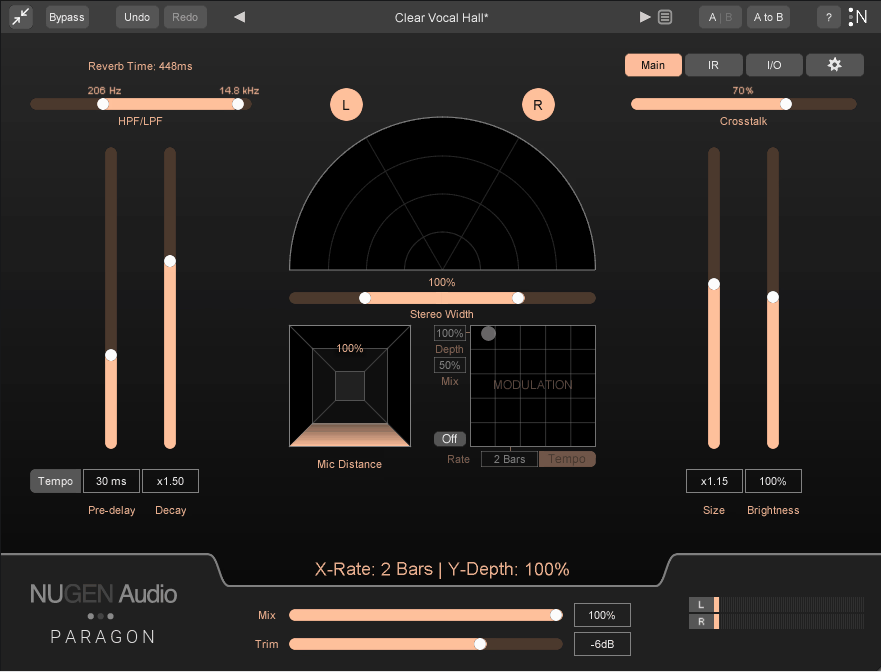
Re-synthesis is the core idea behind this reverb: instead of playing back a fixed recording, the engine rebuilds the reverb tail in real time from acoustic measurements.
The result, marketed as the world’s first 3D-compatible convolution reverb, is NUGEN Audio Paragon, which can stretch decay, room size, and brightness far past what the original captured space offered, without introducing artifacts.
Because the reverb is generated through re-synthesis instead of played back from a fixed recording, you can push decay and room size well beyond the original captured space, and I think that alone cuts down on needing dozens of similar-sounding presets.
- Ambisonic B-Format Capture
Every impulse response was captured as a B-format Ambisonic recording, which means the same core IRs can output to formats from mono all the way up to 7.1.4, including Dolby Atmos beds.
- Spectral Analysis and IR EQ
An IR page gives you a spectral analysis view alongside precise EQ over the impulse response itself, letting you adjust decay time in relation to frequency. I found the visual feedback genuinely helpful here, more than I expected from a technical page like this.
- Configurable Per-Channel Crosstalk
Adjustable crosstalk between channels creates a sense of liveliness and interaction, and it’s also what lets Paragon produce convincing surround reverb even from a mono or stereo source.
- Per-Channel Filtering and Switchable LFE
Independent high-pass and low-pass filters per channel, plus a switchable LFE channel, give you tight control over tonal balance across a full immersive mix.
- Paragon ST for Music Production
A separate Paragon ST edition strips things down to mono and stereo and adds music-focused controls like stereo width, mic distance, modulation, and tempo-locked pre-delay. I’d recommend it over the full surround version if you’re not working in Atmos at all.
9. MeldaProduction MConvolutionMB
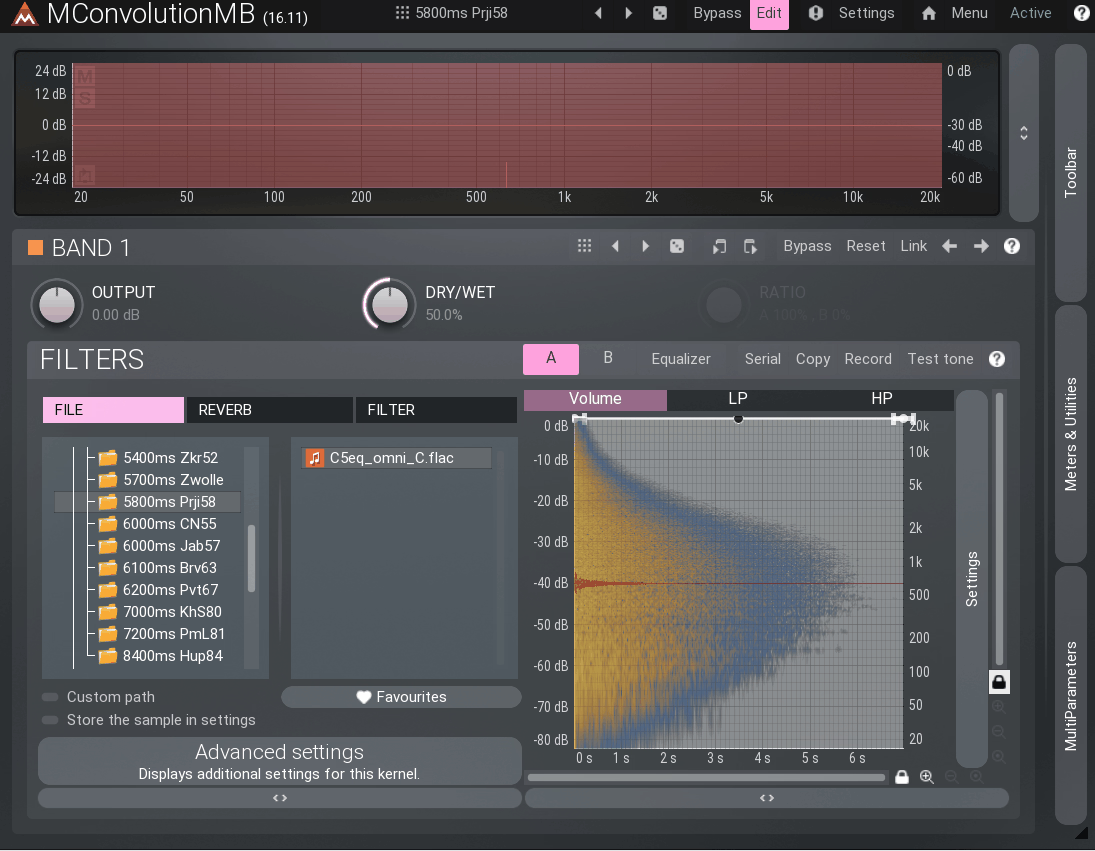
Each frequency band in a mix often calls for a slightly different acoustic treatment, tight and controlled in the low end, more spacious up top. MConvolutionMB splits your signal into up to six bands and lets you apply a separate impulse response to each one.
In addition, each band supports two IR slots at once, with a blend control and modulation between them, so a single band can morph from one impulse character to another over time instead of sitting static.
Other than that, you get:
- Built-In IR Generator
Beyond loading files, the plugin can generate reverbs and filters from scratch internally, which I think is a genuinely useful fallback when you don’t have the exact impulse you’re looking for on hand.
- Four Flexible Modulators
Four modulators, each capable of working as an LFO, envelope follower, randomizer, or pitch detector, can control nearly any parameter in the plugin, including listening to your sidechain input.
- True-Stereo File Support
The file manager recognizes multichannel WAV files and can combine multiple files into a true-stereo setup automatically. I’d say that’s a small detail that saves real time once you’re working with proper true-stereo impulse libraries.
10. Spitfire Audio AIR Studios Reverb
AIR Studios Reverb: over 67,000 impulse responses of Lyndhurst Hall, a room AIR Studios had strictly never allowed anyone to sample before this plugin existed. Spitfire’s proprietary Virtual Positioning Technology lets you place a sound source anywhere in that hall and hear exactly how it would have been captured from that spot.
- Virtual Positioning Technology
I think VPT is genuinely the standout feature here, since it lets you move a sound source around the hall in real time instead of picking from a fixed set of mic positions like most convolution reverbs offer.
- Eight True Stereo Mic Signals
You can blend up to eight individual true stereo mic signals, which gives you a level of control over the room’s character that a single fixed IR simply can’t match.
- Adjustable Hall Parameters
Canopy height, canopy material, hall layout, and gallery dampening are all adjustable, recreating physical changes that would normally require an actual crew moving actual equipment in the real room.
- 54 Curated Presets
The Spitfire team put together 54 presets based on real mixing sessions at AIR. I’d recommend starting there before diving into manual positioning, just to get a feel for what the hall is actually capable of.
11. LiquidSonics Reverberate 3
Fusion-IR is the proprietary technology at the center of this whole plugin, a multisampled, interpolatable impulse response format that behaves nothing like a static recording.
Reverberate 3‘s modulation tools let you push captures from iconic hardware closer to the original than ever, or far enough away that they become something else entirely.
- Fusion-IR Technology
Because Fusion-IR captures are interpolatable instead of fixed, the reverb genuinely evolves over time rather than repeating the same static tail on every hit, which I think is the single biggest reason this sounds more alive than standard convolution.
- Free Fusion-IR Expansion Packs
You get free access to Fusion-IR libraries modeling the Lexicon 480, Lexicon 224, and Bricasti M7, among others, without any additional purchase required.
- Extended Split Modulation
Pitching and non-pitching delay and time modulation let you apply anything from subtle natural movement to fairly dramatic transformation on any static impulse response you load in.
- Enhanced True Stereo Simulation
You can now modulate the simulated crossfeed channels themselves, adding life to the stereo image without disturbing the essential structure of the sampled reverb underneath.
- Dual Impulse Blending
Two separately controllable true stereo or Fusion-IRs can be blended together, and I’ve found combining a tight early-reflection capture with a longer, lusher tail from a completely different source gives genuinely useful hybrid results.
12. Heavyocity VAST (Not Only a Reverb)
It doesn’t limit itself to being a straightforward reverb, and that’s really the point of including it here. Because the modular chain runs convolution, gate, compression, EQ, and delay modules in whatever order you rearrange them, Heavyocity VAST ends up functioning as much like a sound design tool as a traditional reverb plugin.
- Fully Rearrangeable Module Chain
You can reorder the convolution, gate, compression, EQ, and delay modules however you want, which I think is what actually separates this from a typical reverb with a few bonus effects tacked onto the end.
- Over 200 Impulse Responses Plus Custom Import
More than 200 factory impulse responses are included, and you can load your own audio files as impulses too, so the source material never runs out if you’re the type to keep hunting for something new.
- Auto Resonance
This feature scans the loaded impulse and automatically reduces problem frequencies caused by room acoustics or the source recording itself. I found this genuinely useful for cleaning up impulses that otherwise sounded a bit harsh or ringy.
- Reverse Impulse and 13-Parameter Convolution Module
The core convolution module alone packs 13 controls, covering tempo-synced IR length, pre-delay, pitch, resonance, modulation, diffusion, and independent stereo imaging across low and high frequencies, plus a reverse option for building reverse-reverb effects.
Freebies:
Wave Alchemy Magic7
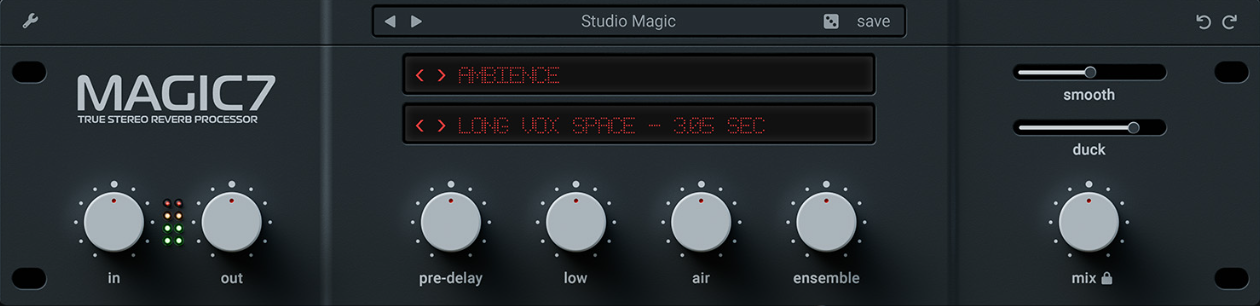
The Bricasti M7 is a roughly $4,000 rackmount reverb that’s become something of a benchmark among mixing and mastering engineers. You get that exact sound, or at least Wave Alchemy’s faithful recreation of it, for free in Magic7, which includes all 234 of the M7’s original factory presets in true stereo.
- 11 Reverb Types, 234 Presets
Presets are organized across 11 reverb types, including Ambience, Chambers, Halls, Plates, Rooms, and Nonlinear spaces, so you’re not stuck scrolling through one giant undifferentiated list.
- Flux and Ensemble Modulation
Two modulation styles, Flux for subtle movement and Ensemble for a richer, warmer chorus effect, go beyond what the original hardware offered. I like that Wave Alchemy added genuinely new capability instead of just cloning the M7 one-to-one.
- Ducking and Transient Smoothing
A built-in ducking control and a Smooth parameter for reducing transient volume without touching the dry signal round out the custom DSP additions, both of which I found genuinely useful once I actually started using them on busy mixes.
- Load Your Own Impulse Responses
You’re not limited to the built-in library, since any external impulse file can be loaded directly, which I think makes this genuinely useful beyond just a quick reverb fix.
Convology XT by Impulse Records & Wave Arts
Convology XT was built as a genuinely free sampler of Impulse Record’s much larger paid library, and it still ships with more than 70 vintage impulse response files pulled from real hardware units. There’s no iLok, no time limit, and no frustrating unlock process to deal with.
- Fast Library Browsing
You can click through impulse responses while audio is actively playing, hearing each one in real time, which I think makes comparing options genuinely fast instead of the usual load-and-wait cycle.
- Zero Latency With Modification Tools
Stretch, decay scaling, EQ, and pre-delay controls all sit on top of a zero-latency engine. I’d say that combination of flexibility and no added delay is pretty rare for a completely free plugin.
- True Stereo Support
Four-channel true stereo impulse responses are supported directly, and additional paid libraries from Impulse Record slot right into the same free plugin if you ever want to expand beyond the included 70.
Halls Of Fame 3 Free
The full version of Halls Of Fame 3 covers 13 legendary hardware reverb units spanning 50 years, from the EMT 240 to the Bricasti M7. You get two presets from every single one of those 13 units in the Free edition, giving you a genuinely useful taste of the full library at no cost.
- 13 Legendary Hardware Units
The included units span both vintage analog gear like the EMT 240, EMT 250, and Lexicon 224, and later digital units like the Lexicon 96, TC 600C, and Bricasti M7.
- True Stereo Recording
Everything was captured in both stereo and true stereo using premium recording gear, which I think shows in how convincingly wide and natural these presets sound compared to a lot of free convolution content.
- Fully Automatable Parameters
Every parameter, including start and end points on the impulse itself, can be automated in real time, giving you more flexibility than the original hardware units ever offered.

Hey, I’m Vil, I started this site to help you find the best audio plugins covering various categories including synths, pianos, strings, and effect tools of all sorts as well. I pick these plugins based on various criteria so it best matches the actual topic.